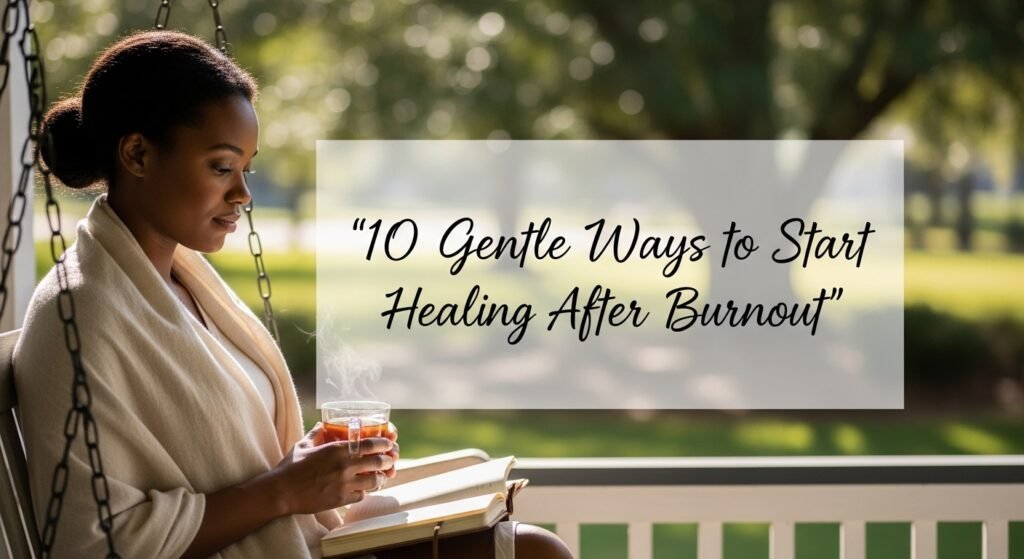
A quiet return to yourself — one soft step at a time
There was a season I don’t talk about much.
Not because I’m ashamed — but because I was too tired to hold words back then.
I remember waking up and feeling like I had already lost the day. My body would move, but my soul lagged behind. I was present, but not whole. Smiling just enough to survive spaces where I couldn’t fall apart. People saw strength, but they didn’t see the unraveling underneath — the numb mornings, the quiet tears in parked cars, the heavy silence after the kids went to sleep. I wasn’t lazy. I was exhausted in a way that sleep couldn’t fix.
That was burnout. And what no one tells you is that crawling out of it doesn’t look like a comeback. It looks like lying down. Letting go. Whispering your own name again after forgetting it in everyone else’s noise.
This list isn’t a cure. It’s a soft offering. A little room to breathe. For the woman who’s still holding on by a thread but somehow still showing up. I wrote this for her. For you. For the version of us that needs healing to feel like an exhale — not a task.
1. Start With Stillness

Let silence become your sanctuary.
There’s a kind of quiet that doesn’t feel like loneliness — it feels like coming home. When you’ve been stuck in the noise of survival mode, stillness can feel foreign at first. But beneath the silence is your own voice, soft and steady, waiting to be heard again.
Start with five minutes in the morning. No phone. No demands. Just sit. Breathe. Listen to what the silence says when you stop trying to fill it. You might hear sorrow. You might hear relief. But most importantly, you’ll hear you.
You don’t have to meditate or journal or produce peace. Just exist. And let that be holy.
Picture This: You sit in the golden hush of early morning, your blanket tucked beneath your chin, the world still sleeping while you finally feel yourself waking up.
2. Let Your Body Rest Without Earning It

Rest is not a reward. It’s a right.
There was a time when even sitting still made me anxious. Like if I wasn’t doing, I wasn’t deserving. I’d feel the weight of dishes in the sink, the shame of unanswered texts, the guilt of taking a nap when I could’ve been working on something — anything — to prove I was still useful. Rest felt like rebellion. Especially as a Black woman, raised on survival and reinforced by systems that confuse burnout with worth.
But healing asked something different of me. It didn’t want another task. It wanted surrender.
So I started small. I stopped waiting for the house to be clean or for my to-do list to shrink before I allowed myself to lie down. I let the bed hold me in the middle of the day — unshowered, undone, unashamed. I let my body feel soft again, not because I finished everything, but because I’d done enough just by breathing through the weight of that day.
Some days, rest looks like an early bedtime. Other days, it’s letting yourself cry on the couch with your favorite throw over your legs. Don’t wait for permission to pause. You’ve already survived enough. Your rest is not up for negotiation.
Picture This: Sunlight spills across your unmade bed as you curl into the pillows, not to escape the world — but to return to yourself. No explanations. Just rest, real and unrushed.
3. Write It Out, Even If It’s Messy

There is medicine in your handwriting.
I used to think I had to wait until I had the right words to write. Like journaling was only for people who already knew what they were feeling — who had clarity and calm and the space to make things poetic. But when burnout had me numb and confused, my mind was too foggy for perfect sentences. All I had were fragments. Scribbles. Rambling thoughts and buried aches that didn’t make sense on paper… but felt like relief in my chest.
So I stopped writing to be understood. I started writing to unburden. No grammar checks. No audience. Just the sacred act of getting the weight out of my body and onto the page.
Some mornings I wrote a sentence. Other days, I wrote until my hand hurt. And sometimes, the page stayed blank — but even showing up to it was a kind of healing. Like saying, I’m still here. I’m still listening to me.
Journaling doesn’t have to look pretty to be powerful. Let it be chaotic. Let it be raw. Let your pen tell the truth before your mouth is ready. That, too, is a form of returning.
Picture This: You curl up at your kitchen table, journal cracked open beside a half-drunk cup of tea, your pen moving like a prayer — spelling out the pain you couldn’t say out loud.
4. Reclaim Your Yes — And Your No

You do not have to explain your peace.
There was a stretch of my life where “yes” rolled off my tongue before I even considered what it would cost me. I said yes to the overtime shift. Yes to the last-minute favor. Yes to the group chat when I really needed silence. I said yes because I was afraid of being seen as selfish. Because I’d been taught that being dependable meant being available — even when I was unraveling inside.
But burnout has a way of revealing the spaces where you’ve abandoned yourself in the name of being needed.
One day, I woke up and realized: every yes I gave away too easily became a quiet betrayal of the woman I was trying to become. So I started practicing a new kind of honesty — one rooted in reverence, not rebellion. I started saying no with softness, and yes with intention.
“No, I can’t make it.”
“Yes, I need rest.”
“No, I don’t have the capacity right now.”
“Yes, I’d love to — just not today.”
At first, it felt clumsy. I worried people would be disappointed. Some were. But the peace that followed? It was worth it. Every boundary I honored became a step closer to freedom.
You are allowed to change your mind. You are allowed to leave things unfinished. You are allowed to say no without guilt — and yes without resentment. Both are sacred. Both are yours.
Picture This: You stand barefoot on your porch, phone in hand, and instead of forcing yourself to show up for something your spirit can’t carry, you send a graceful “not today” — and feel lighter for it.
5. Create a Soft Morning Ritual

Begin the day with something that begins with you.
There was a time when my mornings started in a frenzy — alarms, notifications, rushing from bed to task to responsibility before I even knew how I felt that day. My feet hit the floor before my spirit had a chance to catch up. And somehow, by noon, I already felt behind.
But healing taught me this: how you enter the day matters. Not just what you do, but how you treat yourself in the doing.
So I began again. Not with a full-blown morning routine, but with one soft act of care.
Some mornings, it’s lighting a candle before the sun rises. Other days, it’s playing an old gospel song that reminds me who I am. On the best days, it’s just five deep breaths and a whisper: “You don’t have to rush, baby. We’re doing this slow.”
You don’t need a perfect system or three pages of journaling before breakfast. You just need a moment that feels like yours — where your healing gets to take up space before the world tries to shape you.
Let that be enough. Let that be sacred.
Picture This: Soft music hums through your quiet kitchen as you stir a spoon through your favorite tea. The light is low, your robe wrapped around you like an embrace, and you whisper good morning — not to the world, but to yourself.
6. Let Nature Hold You
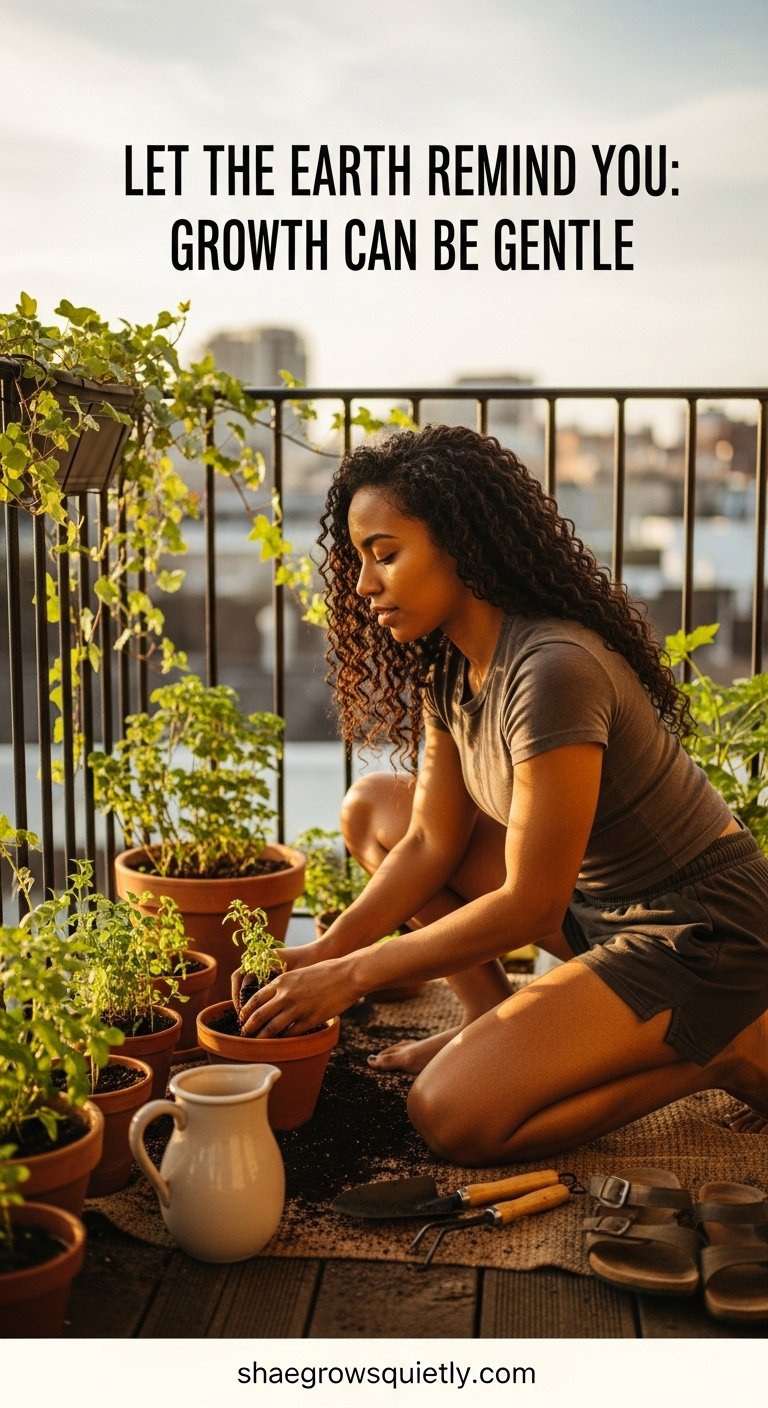
Healing doesn’t always happen in a journal. Sometimes, it happens in the dirt.
When I was too overwhelmed to think clearly, too tired to write, too numb to cry, I found myself reaching for plants. At first, it was unintentional — a little pot of mint on the porch, a houseplant in the kitchen window. But over time, I noticed something: the more I tended to them, the more I began to tend to me.
Nature didn’t ask me for productivity. It didn’t care if I was dressed for the day. It didn’t judge the heaviness I carried. It simply invited me to be — quietly, without pressure. Just like the soil holds the seed, it held space for me to breathe, break down, and begin again.
There’s something holy about putting your hands in dirt. Watching something small grow under your care — even if it’s just one green sprout curling toward the sun — reminds you that you still have life in you. That even in your stillness, something is becoming.
Whether it’s watering the plants, walking barefoot in the grass, or sitting under a tree with no goal but presence… let the earth remind you: you were never meant to do all this healing alone.
Picture This: Barefoot in the morning dew, you kneel beside a small pot of basil, your hands covered in soil, your breath finally slowing. The sun warms your back as the leaves uncurl toward light — and something inside you does too.
7. Unplug and Come Back to Your Senses

The world will keep spinning. You don’t have to chase it.
There were days when I didn’t even realize how overstimulated I was. I’d scroll endlessly, half-laughing at videos I wouldn’t remember, responding to messages with tired fingers, and still feeling empty afterward. Even in my own home, I was rarely with myself. I was performing — producing, reacting, consuming.
And then one day, I turned everything off. Not in protest. Not forever. Just for a moment. And in that silence, I heard birdsong I hadn’t noticed in weeks. I smelled the cinnamon in my tea. I felt the soft cotton of my robe on my skin. It wasn’t dramatic. It was real. It brought me back.
We spend so much time plugged into devices that we forget we are devices too — powered by breath, grounded by touch, moved by beauty. When you unplug, even briefly, you return to the rhythm of your own body. You start to notice the things that are still good. Still soft. Still here.
So pause the scroll. Close the tab. Step outside. Light a candle and feel its warmth. Let your senses lead the way back home.
Picture This: Your phone is tucked in a drawer, and in its place is a lit candle flickering beside your open window. You’re curled on the couch, wrapped in a knit blanket, sipping something warm, eyes closed, finally remembering what peace feels like.
8. Speak Kindly to Yourself — Out Loud

Let your voice become a place of safety, not shame.
There was a time I couldn’t catch a break — not from the world, and not from myself. I’d move through my day with grace on the outside, but inside? My thoughts were sharp. I’d whisper things to myself I would never say to another woman. “Why are you like this?” “You should’ve done more.” “This is why you’re always behind.”
And somewhere along the way, I realized… I was breaking my own heart.
So I started talking back — gently at first. A soft “You’re trying” when I missed a deadline. A whispered “You’re still worthy” when the mirror felt too honest. Then, on the days that almost broke me, I said the hardest thing of all: “You don’t have to earn love today. You already are it.”
And y’all… something shifted. Speaking out loud gave the kindness more weight. It felt real. My voice, once used to push through pain, became a balm. It reminded me that I could be both healing and whole. Both growing and already enough.
You don’t have to wait until you feel confident to speak life over yourself. Speak it now. Speak it shaky. Speak it like you mean it — even if part of you doesn’t believe it yet. That’s how healing begins to bloom.
Picture This: Standing barefoot in your bathroom, bonnet on, eyes tired but honest, you look in the mirror and whisper, “I forgive you. I love you. You are still becoming.” And for the first time in a long time, you believe it… even just a little.
9. Let Laughter Back In

Joy doesn’t mean you’re not still healing — it means you’re still human.
For a while, I forgot how to laugh. Not the polite chuckles you give in conversation — I mean that deep, shoulder-shaking, throw-your-head-back kind of laughter that feels like sunshine cracking through heavy clouds.
After burnout, I felt guilty for even wanting that kind of joy. Like if I was really hurting, I shouldn’t be allowed to enjoy anything. I caught myself brushing off things that once made me smile, skipping over silly moments, refusing levity like it would somehow discredit my pain.
But joy is not the opposite of healing — it’s part of it.
The first time I laughed after a long stretch of numbness, it caught me off guard. I was watching a random video late at night, hair tied up, sitting on the couch with a bowl of popcorn I didn’t feel like sharing — and I just lost it. Not because life was perfect, but because something small reminded me that I was still alive.
And that moment? It was medicine.
Let laughter live in your home again. Watch your favorite movie for the fifth time. Tell that inside joke with your best friend. Let something silly break through the seriousness of survival. You don’t have to feel healed to feel joy.
Picture This: You’re sitting cross-legged on the couch, hoodie half-zipped, popcorn in your lap, head tossed back in a full, unfiltered laugh — no makeup, no filter, just soft joy sneaking in like an old friend you almost forgot you missed.
10. Ask for Help — And Let It In

You were never meant to carry all of this alone.
I used to wear independence like armor. I prided myself on doing it all — not because I wanted to, but because life taught me that needing help came with strings, judgment, or disappointment. So I learned to swallow my tears, push through the hard days, and say, “I’m good” even when I was falling apart.
But behind that strength was a woman quietly unraveling. And eventually, silence wasn’t strength — it was suffering.
The turning point didn’t come with some big breakdown. It was a quiet moment, phone in hand, staring at a contact I almost didn’t call. And when I finally did — when I let the words “I need help” slip out — I was met with love, not shame. Support, not suspicion. Just someone breathing with me, saying, “You don’t have to do this by yourself.”
Asking for help isn’t weakness. It’s wisdom. It’s saying, “My healing matters enough to be supported.”
Whether it’s a therapist, a friend, a support group, or someone who can just sit with you in the quiet — let them in. Let someone witness you without trying to fix you. That, too, is part of the healing.
Picture This: Your phone pressed to your cheek, voice barely above a whisper, you finally say what you’ve held in for weeks: “I’m not okay.” And on the other end, a soft reply: “That’s alright. I’ve got you.”
Reflection
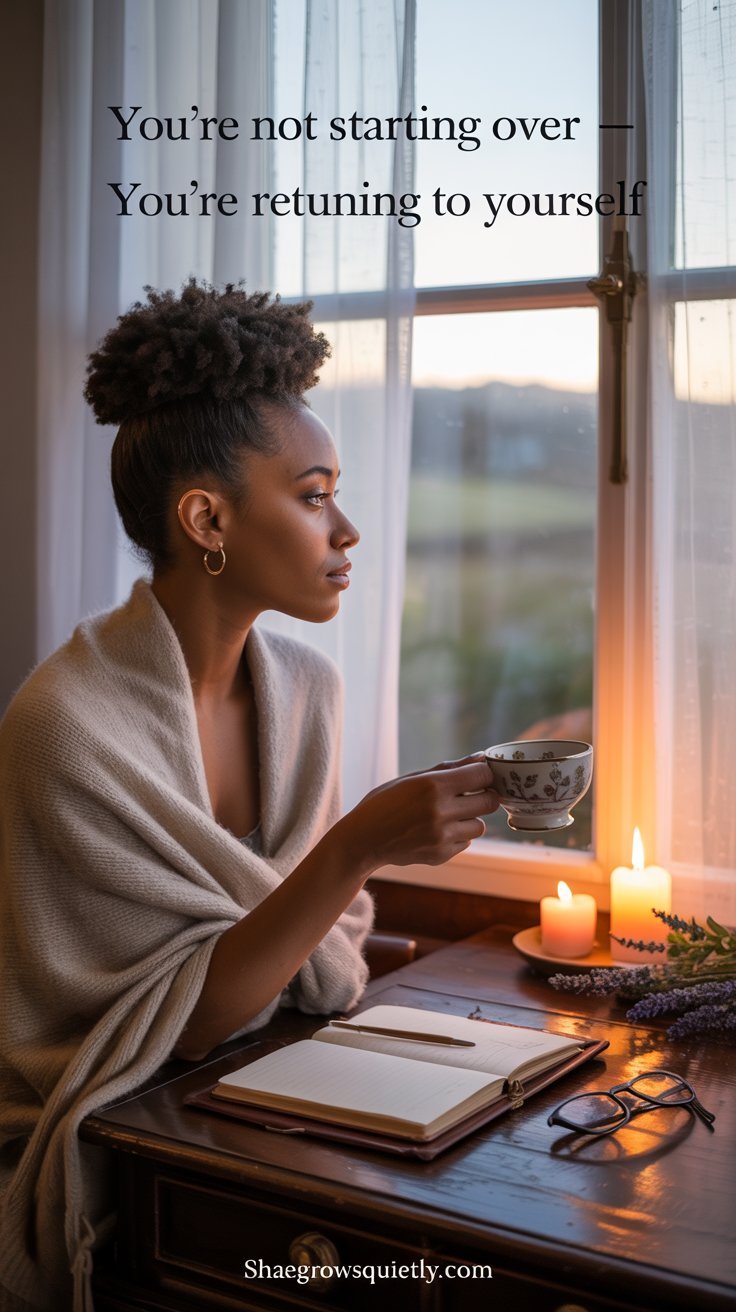
Healing after burnout isn’t a straight path — it’s a spiral. Some days you’ll feel whole. Other days you’ll feel like you’re starting over. Both are sacred. Both are part of it.
You don’t have to rush your return. You don’t have to glow up to be good. This isn’t about reinventing yourself — it’s about remembering yourself. The you beneath the exhaustion. The you who deserves slow mornings, honest boundaries, soft laughter, deep rest, and support that doesn’t have to be earned.
If all you did today was read this, breathe a little deeper, and whisper “I’m still here” — that’s enough. That’s more than enough.
Let this be your permission slip to heal quietly. To tend to yourself the way you’ve tended to everyone else. To take up space in your own life again — gently, bravely, and without apology.
Picture This: The day winds down and you sit wrapped in a blanket that smells like home, a candle flickering nearby. You exhale slow and deep, realizing for the first time in a long time — you’re not rushing anymore. You’re resting. You’re healing. And you’re home.