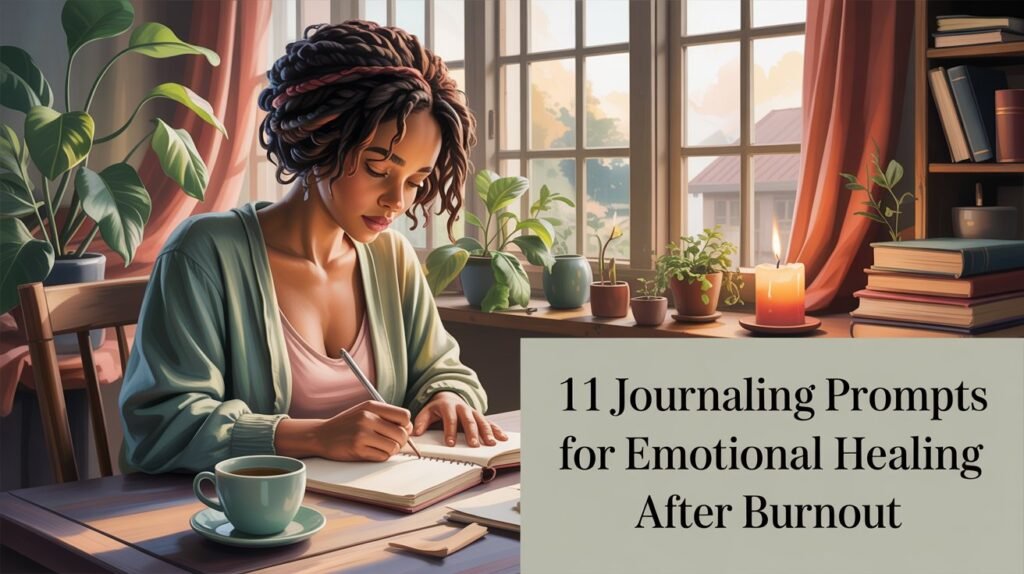
A quiet guide to writing your way back to yourself.
In the thick of burnout, it can feel like your thoughts don’t even belong to you anymore. Like the world’s weight crawled up into your mind and made a mess. But writing — slow, quiet, uncensored writing — can be a soft kind of salvation. It’s where the tangled emotions finally spill. It’s where you remember yourself.
This isn’t about perfect grammar or pretty quotes. This is about release. It’s about truth. And most of all, it’s about healing — the kind that starts small, like whispered prayers on paper. So if your soul is weary and your spirit stretched thin, these prompts are for you. No pressure. Just permission.
Letting It Out — Writing What Burnout Took

Before we can rebuild, we have to release. And to release, we have to remember. These first prompts are invitations to tell the truth — not the polished version, but the raw one. The version we stuffed down while smiling through pain, clocking into jobs that drained us, and pouring from cups that hadn’t been full in years.
These aren’t questions for your mind to fix. They’re questions for your soul to answer — gently, one breath at a time.
1. “What did I keep pushing through when my body begged me to stop?”
We don’t always realize how long we’ve been running on fumes until our body starts to shut down. But looking back? My body had been whispering to me for a while — I just kept shushing it.
I remember those 12-hour CNA shifts when I’d barely sit down, when eating was a luxury and silence was rare. My feet throbbed like they were screaming, and still I kept going — lifting, bending, wiping, smiling. I thought endurance meant strength. I thought pushing through was what love looked like. But all the while, my body was pleading with me to listen. And I just… didn’t know how.
2. “What did burnout take from me that I’m still grieving?”
Burnout doesn’t just exhaust you. It quietly takes things from you — your spark, your softness, your sound.
I stopped dancing in the kitchen. I stopped laughing from my belly. I stopped writing. I stopped dreaming. I became efficient but hollow. People said I was strong, but I felt like a ghost of myself — floating through tasks with no joy in the doing. I’m still grieving the woman I was before survival became my full-time job. But I’m also learning… she’s not gone. Just buried beneath everything I carried that wasn’t mine.
3. “When did I first realize something wasn’t right — and what did I do instead of rest?”
There was this one morning after a night shift — I’d slept maybe two hours. I was sitting in my car in the hospital parking lot, staring at the dashboard like it owed me answers. My hands were on the wheel, but I couldn’t move. I just… sat there. Not because I didn’t have somewhere to be. But because I didn’t have the strength to pretend anymore.
Still, I went inside. Clocked in. Did the work. I put my tired soul in a uniform and gave what I didn’t have. Because rest felt like weakness, and weakness felt dangerous. I didn’t know how to stop without unraveling completely. So I didn’t stop. Until my body made the choice for me.
4. “What did I make look easy that nearly broke me?”
Whew… this one’s tender.
I made caregiving look easy. I made motherhood look graceful. I made working doubles and coming home to homework and hungry mouths look like clockwork. But behind closed doors? I was unraveling.
I remember folding laundry at midnight, tears dripping onto warm towels, my chest heavy with silent screams. I’d show up the next day smiling, hair slicked, uniform pressed — nobody saw the woman breaking beneath the weight of “keeping it together.” That mask? That performance? It almost took me out. But I didn’t know how to ask for help when I didn’t even feel worthy of rest.
Picture This: You’re curled up in the quiet — candle lit, pen in hand, finally breathing deep. There’s no pretending here. No performing. Just you and the page. You start writing what burnout stole, and for the first time, the truth feels like a form of freedom.
Naming the Numbness — Understanding What Burnout Felt Like

Burnout doesn’t always scream. Sometimes, it tiptoes in like a thief, stealing little pieces of you while you’re busy trying to keep up appearances. It doesn’t just drain you — it erases you slowly. Gently. So gently you don’t even notice the loss until you’re standing in front of a mirror wondering where the light went.
These prompts are about facing that hush — the one that settled in your spirit when your fire dimmed. We’re not trying to fix it here. Just trying to name it, so we can stop blaming ourselves for surviving it.
5. “How did burnout change the way I showed up in relationships?”
I didn’t mean to drift. But I did.
Calls went unanswered. Texts sat blinking. My kids would tell me stories and I’d nod… but not really hear. It wasn’t that I stopped caring — I just didn’t have the strength to carry one more feeling. So I shut down.
I pulled back from the people who loved me most, because even love felt like a responsibility I couldn’t meet. I needed rest, not connection. But I didn’t know how to say that out loud. So I let the distance grow. Quietly. Softly. Like fog rolling in over the things I used to hold close.
6. “What parts of myself did I stop recognizing?”
I used to be radiant.
Not in the Instagram way — but in that real, everyday joy kind of way. I used to sing while making breakfast granted I might’ve missed a note or two but it came from a place so pure and untouched. I’d find a reason to smile in a sky full of clouds. Before burnout, I could not only see but feel Beauty — you know the simple kind, of grandma sitting on the front porch in that ugly house dress shelling peas and humming a hymn, yep that’s the one it mesmerized my soul. But somewhere between bills, heartbreak, and back-to-back shifts, I went missing.
I looked up one day and realized I hadn’t laughed from my belly in years. I didn’t sing off key all loud filling in the blanks with my own nonsense anymore. Didn’t dance in the kitchen. Didn’t write for fun or tell off putting jokes that know one understood but me . My softness turned sharp. My edges grew hard. I didn’t recognize the woman doing everything right and still feeling like she was losing.
7. “How did I numb myself to cope?”
At first, I didn’t call it numbing. I called it survival.
I filled every silence with something — scrolling, eating, cleaning, caretaking. Anything to avoid sitting still. Because stillness made space for the ache. And that ache? It scared me.
I remember standing in the shower, letting the water run too long, hoping it would wash away more than dirt. I’d turn the music up to drown out the noise in my head. I didn’t want to feel, because I didn’t have the luxury to fall apart. Not with kids watching. Not with bills due. So I kept myself busy. But that busyness became my prison.
Picture This: You’re sitting in the hush of your bedroom, lights low, incense burning slow. You finally let yourself say it: “I’ve been tired for a long time.” Not just in your bones, but in your spirit. And instead of running from that truth — you write it down. You hold space for it. And in that space… something starts to loosen.
Reclaiming Softness — Writing the Woman Underneath the Survival Mode

Sometimes we armor up so well, we forget there was ever a softness underneath. But she’s still there. Still waiting. Still worthy.
These prompts are a quiet call back to your gentler self — the you that existed before exhaustion. Not to shame the survivor you became, but to honor the tender one you had to set aside just to get through the storm.
8. “What did I miss about myself when I was just trying to make it?”
I missed the version of me that giggled over small things. The me that lit candles just because, that made banana pudding on slow Sundays, that wore her favorite perfume even if she had nowhere to go.
I missed the me who wasn’t always counting coins or minutes or emotional energy. She didn’t just exist, she lived. I didn’t realize how much I mourned her until the world got quiet… and I finally had room to listen to my own longings.
9. “What would it look like to be soft again — and feel safe in that softness?”
At first, softness scared me. It felt like a luxury I couldn’t afford. I thought it meant weakness — like the world would eat me alive if I stopped bracing for the next blow.
But I’m learning now that softness isn’t passive. It’s powerful. It’s choosing rest when the grind says go. It’s crying in the middle of the grocery store because your heart is tender — and you no longer apologize for it.
Softness, for me, looked like journaling again. It looked like saying “no” without guilt. Like taking my time in the mornings, sitting in silence with tea, letting the world wait for me for once. And slowly, that softness started feeling like home.
Picture This: You’re wrapped in a cotton robe, sun warming your face through the window, a half-written page in your lap. For the first time in forever, you’re not rushing. You’re not explaining. You’re just being. And in that softness, you feel yourself returning — not the old you, but the truer you.
Rebuilding With Intention — Writing a New Way Forward

Healing after burnout doesn’t mean rushing into a new hustle. It means asking, “What do I actually want?” — and being brave enough to listen to the answer. These prompts help you move from reaction to intention, from just surviving to softly choosing.
This is where your healing starts to stretch its legs. Where you begin rebuilding a life that doesn’t demand your exhaustion as proof of your worth.
10. “What kind of life do I want to build from this place of awareness?”
When I finally stopped running, I had to face a hard truth: I didn’t even know what I wanted. I had been so busy surviving — for years — that desire felt like a language I no longer spoke.
But slowly, the answers started to whisper back. I want peace. I want mornings that don’t start in panic. I want to work from my laptop with tea in hand and not dread what the day holds. I want to raise my babies without resentment simmering under my skin. I want room to laugh, to write, to rest, to bloom.
So that’s the blueprint I’ve started following. Not perfectly, but faithfully. One soft decision at a time.
11. “What do I now know I will never go back to?”
This one’s sacred. Because once you name it, it can’t be unnamed.
I’ll never go back to ignoring my body’s cries just to keep a job. I’ll never go back to measuring my worth by how exhausted I am. I’ll never go back to letting everyone else eat first while I starve — emotionally, spiritually, physically.
Burnout taught me boundaries. And baby, I paid for that lesson in tears, in time, in fragments of myself I’m still piecing back together. But now? I guard my peace like it’s the most precious thing I own. Because it is.
Picture This: You’re sitting at a sunlit desk, plans written in soft ink, your breath steady. Outside, the world still spins fast — but in here, you’ve slowed down. You know what you’re building. And more importantly, you know what you’ll never build again.
A Soft Return to the Woman Within

Healing after burnout isn’t loud. It doesn’t show up like fireworks or applause. Most days, it’s quiet — like turning down the volume on the world so you can finally hear yourself again.
These prompts? They’re not a checklist. They’re a hand to hold. A mirror. A warm light in the room where you thought you’d lost yourself.
Because truthfully? Burnout doesn’t just empty your tank. It drains your identity. It makes you question your worth, your strength, your softness — especially when the world praised you more for surviving than for being whole.
But sis, journaling gives you space to remember.
To remember who you were before the grind.
To make peace with the woman who kept going when rest wasn’t an option.
To gently gather the pieces and sit with them, not to fix them… but to honor them.
Every time you put pen to page, you’re not just healing — you’re reclaiming. Your voice. Your story. Your power.
And maybe, just maybe, the version of you you’ve been missing?
She’s not gone.
She’s just waiting — beneath the noise, behind the masks —
for the quiet moment when you’re ready to come home.
Let this be that moment.
Picture This:
It’s late. The world is quiet. You sit wrapped in your favorite blanket, journal open, the candle’s flame dancing soft shadows on the wall. There’s no rush, no need to perform. Just you — breathing slower now, writing slower too — rediscovering the sound of your own voice. In this stillness, emotional healing after burnout doesn’t feel like a task. It feels like homecoming.