
A gentle guide for the woman reclaiming her energy, rhythm, and peace
Nobody talks about the part after the burnout.
Not the breakdown. Not the crying in the car or the nights when you fell asleep with your teeth clenched.
But the after. The fog. The awkward stillness when everything is quieter, but nothing feels healed.
You’re no longer in crisis, but you’re not okay either.
You’ve stopped breaking… but you haven’t started becoming yet.
And in that space — that in-between, bone-tired, soul-fragile space — you’re supposed to “get back to it.”

But how do you get back to something that broke you?
What if the way back… isn’t back at all?
I remember sitting at my kitchen table one morning, staring into cold coffee, wondering how a day could feel heavy before it even started. I didn’t want a routine. I didn’t want to optimize my mornings or organize my life into color-coded lists. I wanted to feel safe again — in my body, in my breath, in my own damn presence.
That’s when I started choosing softness. Not as an aesthetic, but as survival.
Ten minutes here. A pause there. A moment of quiet in a world that only clapped for loud.
These soft routines didn’t change my life overnight.
But they did help me build a new one — slowly, quietly, honestly.
One that didn’t demand I hustle to be whole.
One that let healing move at the speed of breath.
1. The 10-Minute Morning Reset

Start the day like your peace is worth protecting.
Some mornings, I’d wake up already bracing.
Not for a crisis — just for life. The emails. The group chats. The quiet demands of being dependable even when I was depleted.
And even when things got better, my nervous system didn’t know how to stop flinching.
That’s the thing about burnout — it leaves behind echoes.
Even in stillness, your body stays ready to run.
So I stopped trying to “win the morning.”
I just wanted to meet myself in it.
Ten minutes. No phone. No expectations. No pressure to journal or pray or perform.
Just me, and whatever I had to give.
Some days that looks like standing on the porch barefoot, eyes closed, letting the morning wrap around me.
Some days it’s crawling back into bed for a few extra minutes of quiet before anyone needs anything from me.
Some days it’s crying into a mug of tea because I’m still grieving how long I’ve gone without giving myself this kind of care.
It’s not a routine. It’s a reclaiming.
Picture This: The light is soft and golden, brushing against your cheek like a hush. You’re sitting with both hands around your mug, robe heavy on your shoulders, the day not demanding a thing from you yet. And for once, you don’t offer yourself up before you’re ready. For once, the morning starts with you.
2. The Midday Body Check

Because survival taught you to ignore yourself — but healing teaches you to listen.
There’s this strange thing that happens when you’ve lived in survival mode for too long — your body becomes background noise. A vessel you push through the day, not a voice you actually listen to.
I used to go hours without checking in. I’d realize it was 2 p.m. and I hadn’t eaten. I hadn’t peed. My shoulders were up to my ears, my jaw tight, my breath shallow. But I’d keep going, telling myself I was fine — even though I knew I wasn’t.
Burnout made me numb.
Healing taught me to feel again.
And feeling? That’s uncomfortable. Especially when you’re used to performing wellness instead of living in it.
So I started doing these little check-ins. Quiet, simple, unglamorous.
I’d pause mid-task, hand on my chest or belly, and ask:
“Where does it hurt?”
“What needs attention?”
“Do I feel like I’m inside my body… or floating outside of it again?”
It wasn’t always a deep answer. Sometimes it was: Drink water.
Sometimes: Lie down.
Sometimes: You’re holding something that isn’t yours — let it go.
This practice didn’t fix my day.
But it helped me stop abandoning myself in the middle of it.
Picture This: You step away from the noise — just for a minute. One hand rests softly over your heart. The other holds onto the counter. You close your eyes, breathe slow, and ask your body what it needs — and this time, you actually wait for the answer.
3. The Digital Detox Hour
Because your spirit was never meant to live in a scroll.
I didn’t realize how much noise I was carrying until I turned it off.
Not the kind you hear — the kind that hums underneath everything. The kind that lives in your pocket, buzzes in your hand, follows you into the bathroom, into your bed, into the sacred corners of your life that used to belong only to you.
I used to call it rest — curling up on the couch, phone in hand, letting the feed rock me into numbness. But when I put it down, I’d still feel tired. My mind scattered. My spirit nowhere to be found. That wasn’t rest. That was avoidance. That was me running from a quiet I didn’t trust anymore.
So I started leaving my phone inside.
Not every day. Not all the time. Just once — then again. Then again.
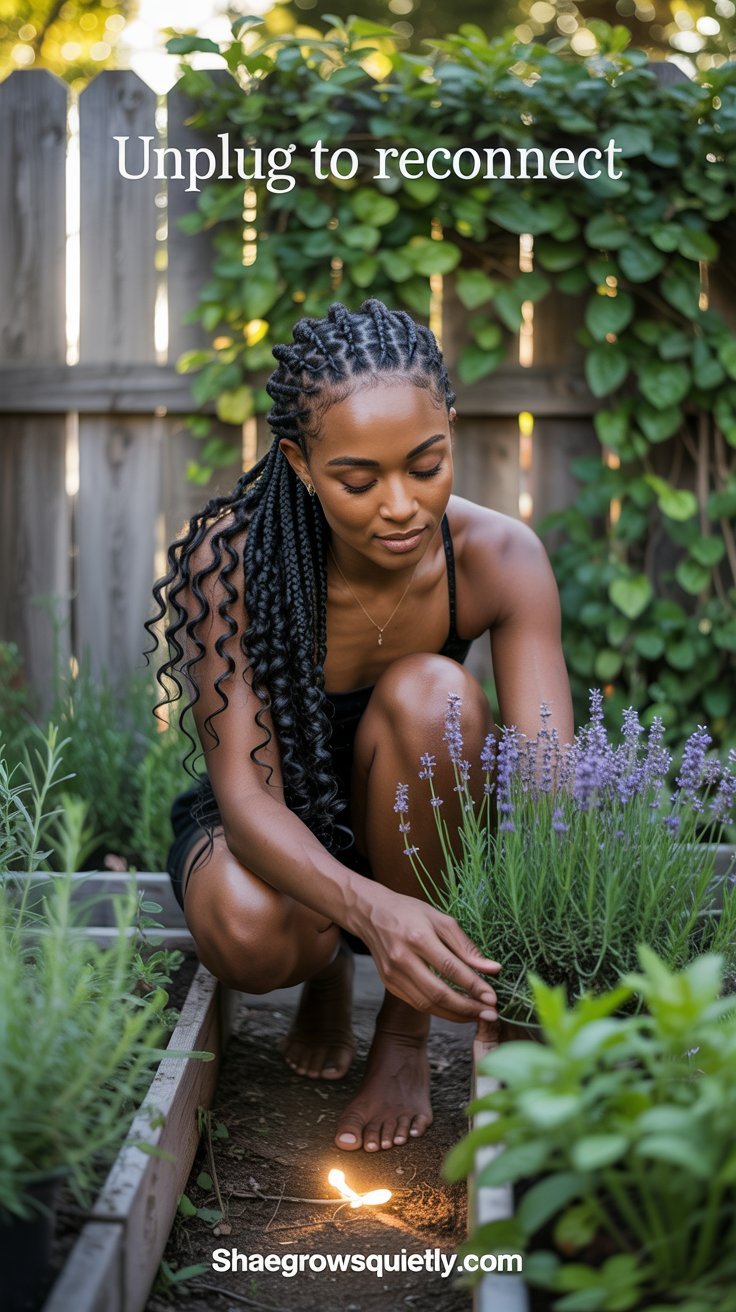
And the garden became my place of return.
There’s something holy about sinking your hands into the dirt — not for beauty, not for Instagram, but because your soul is starving for something real. The earth doesn’t ask for performance. It doesn’t care how many unread emails you have or how long it’s been since you answered that text. The soil receives you as you are. Every time.
I’d pull weeds slow, barefoot and breathing deeper than I had all day.
Water plants like I was tending to my own healing.
Whisper my worries into the wind, knowing the leaves could hold them better than my screen ever could.
And in that hour — in that hush — I found myself again.
Not because I was trying to.
But because I finally stopped trying to be everywhere else.
Unplugging wasn’t about escaping.
It was about coming home.
Picture This: You kneel beside your basil, barefoot, the sun warming your shoulders. Your hands are covered in soil and grace. Birds chatter in the distance. A tomato vine curls upward beside you, thriving under your touch. There is no timeline here, no buzz, no alert. Just the steady, sacred rhythm of life growing — and your presence, soft and full, right in the center of it.
4. Mindful Meals

Because you’re allowed to be fed — even when you’re not “on track.”
There was a time when I ate standing up, rushing, one hand on my hip, the other holding a fork like a deadline. I’d snack while scrolling, chew while driving, reheat the same plate twice because I kept forgetting to sit down and receive it.
Burnout made food feel like a task. Just one more thing to manage.
I’d go hours without eating, then inhale something quick, only to feel empty again — not just in my stomach, but in my spirit.
Because I wasn’t really hungry for food.
I was hungry for care. For slowness. For the kind of presence I kept giving to everybody but me.
So I started blessing my meals. Not with a formal prayer — but with pause. With breath. With presence.
I began lighting a candle beside my plate, not because I needed mood lighting, but because I needed ritual. A moment to say: “This is for me. I matter enough to sit. To chew. To taste. To stop rushing.”
Even when the meal was simple — eggs and toast, rice and beans — I let it be sacred.
No screens. No multitasking. No shame about what it was or wasn’t.
Just food. And a woman rebuilding her relationship with herself one slow bite at a time.
I wasn’t dieting. I was returning.
Not just to hunger — but to deserving.
Picture This: You sit at your kitchen table, a plate of food steaming in front of you. The candle flickers. A soft song hums low in the background. You take a bite and close your eyes — not out of performance, but because you’re letting your body feel fed. The world can wait. Right now, you’re nourishing more than your belly. You’re feeding the part of you that forgot what it meant to be cared for.
5. Soulful Movement

Because I wanted to feel alive again — not just functioning.
There was a morning I stepped out onto the porch and realized I didn’t know what it felt like to be inside my own body.
I’d spent so long pushing through — powering through work, through pain, through another day of being “on.” Even when I rested, I wasn’t really resting. I was collapsing. My body had become this vehicle I used to survive. Something to manage. Something to numb.
But that morning, the breeze touched my skin and I felt it.
Felt it for the first time in what felt like years.
And I didn’t do anything fancy. I didn’t press play on a workout or unroll a yoga mat. I just stood there… barefoot, still, and swaying a little. Slowly. Quietly. Like my body was remembering something I had forgotten — that she belonged to me.
Now when I move, it’s not to change her.
It’s to listen to her.
Sometimes it’s putting on an old song I haven’t heard in forever and letting it carry me around the room.
Sometimes it’s walking slow in the grass, breathing deeper than I did all week.
Sometimes it’s laying on the rug with my arms stretched wide, letting the weight of everything fall off for just a few minutes.
Not to check off a box. Not to burn calories.
But to remind myself: I’m still here. I still feel. I still belong in this skin.
Picture This: The floor is cool beneath your feet. The music is playing low. You’re not trying to keep up. You’re not trying to look good. You’re just moving — arms open, head tilted back, hips slow and loose — like you’re dancing with your own aliveness. Like joy doesn’t have to be earned. Like softness is a rhythm, and your body just remembered the beat.
6. Evening Decompression

Because every strong woman needs a soft place to land.
Evening hits different when you’ve been carrying the weight of the world in silence.
You walk through the door and the whole house sighs — like it knows you’re tired too.
You kick off your shoes slow, not out of exhaustion, but reverence.
Because this is your altar now. This moment, this body, this breath.
And you move through it like ritual.
First stop? The shower.
Hot. Long. Healing.
That water don’t just hit your skin — it reaches the places your words never made it to.
You wash slow, like you’re rinsing off not just sweat and dust, but all the invisible things:
The passive-aggressive comment from your supervisor.
The motherhood guilt.
The way you smiled when you wanted to scream.
And when the steam finally starts to clear, so does something in you.
You wrap yourself in a thick towel like armor laid down for the night,
then pour a glass of wine and let the music do what therapy sometimes can’t.
Some nights it’s Marvin.
Some nights it’s Sade or Lauryn or Beres.
Either way, it gets in your bones and rocks you back into yourself.
You’re not trying to journal. You’re not trying to heal on a timeline.
You’re just letting the day end, without dragging every burden into tomorrow.
That’s enough.
This isn’t about self-care as a performance.
It’s about coming home to yourself without apology.
No audience. No checklist. No guilt.
Just you, the music, and the softness you fought hard to earn.
Picture This: Steam curls from the open bathroom door as music hums low in the background. A warm towel hugs your curves, wine glass in hand, your hips swaying slow to a beat older than your tiredness. No one’s asking for anything. No one’s interrupting your stillness. The day is done — and for the first time, that’s not a burden. It’s a blessing.
7. Gratitude Without Pressure
Because I had to stop saying “thank you” for things that broke me.
There was a time I confused survival with gratitude.
I’d sit in the mess of my life — bone tired, heart sore — and still try to convince myself, “At least I have a job… at least I woke up this morning… at least—”
As if barely making it meant I should be quiet and thankful.
But the truth is…
Some things I survived should’ve never been mine to carry.
And I don’t owe thank-yous for lessons I didn’t ask for — especially the ones that damn near broke me.
Healing taught me that gratitude isn’t about pretending everything’s okay.
It’s about noticing the small things that remind me I’m still here.
The way my shoulders drop when my song comes on.
The sound of my baby laughing in the other room.
The way the wind moves through my garden at sunset, soft like a “you made it.”
It’s not performative.
It’s not for anybody else’s comfort.
Some days, I don’t write a list.
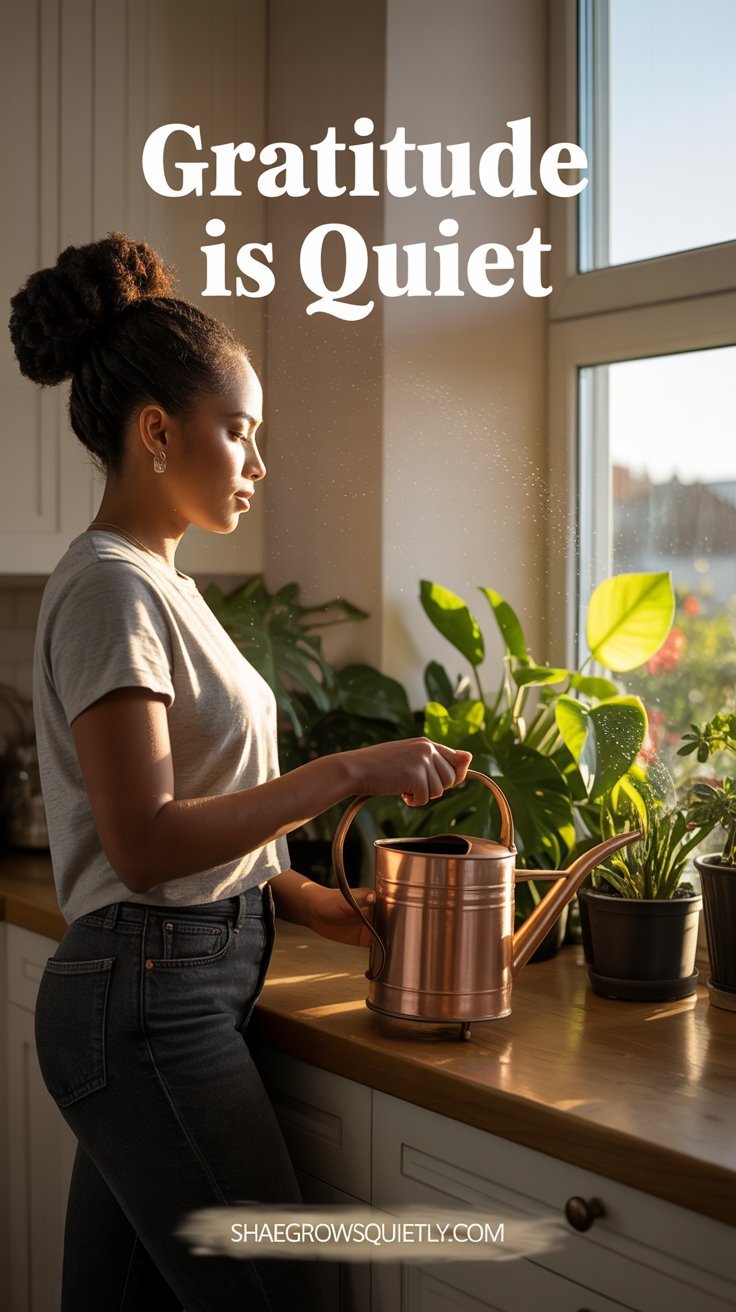
I just whisper “thank you” to the sky as I water my plants, or stir my food, or exhale into the silence.
Not because life is perfect — but because I caught a glimpse of something beautiful in spite of it.
And that’s enough.
Gratitude, for me, isn’t about settling.
It’s about sensing.
Sensing life moving gently through my days again, after so long of feeling numb.
That’s a different kind of miracle.
Picture This: Late evening sun filters through the blinds, casting golden stripes across your kitchen. You hum while washing the last dish, wine glass still on the table, music playing low. You’re not smiling because you’re supposed to — you’re smiling because you feel present. Gratitude rises like steam, unforced, quiet, true. No pressure. Just peace.
8. Weekly Reset Sunday (or any day)
Because sometimes peace don’t just show up — you gotta sweep a path for it.
Growing up, Sundays had a certain hush.
Not quiet like silence, but quiet like presence.
Like something sacred was being stirred with every mop stroke and vinyl scratch.
There was always music —
Not too loud, but just enough to fill the corners.
Al Green melting into Anita. A little Smokey. Gospel somewhere in the background like a second heartbeat.
The windows would be cracked open, even in winter.
The air thick with lemon-scented cleaner and prayer.
It wasn’t just about chores — it was about clearing the air, inside and out.
Now, as a woman rebuilding, I hold that ritual in my own hands.
It don’t always fall on a Sunday — sometimes it’s Wednesday night with a headwrap on and slippers dragging.
But the rhythm is the same:
Music. Movement. Memory. Meaning.
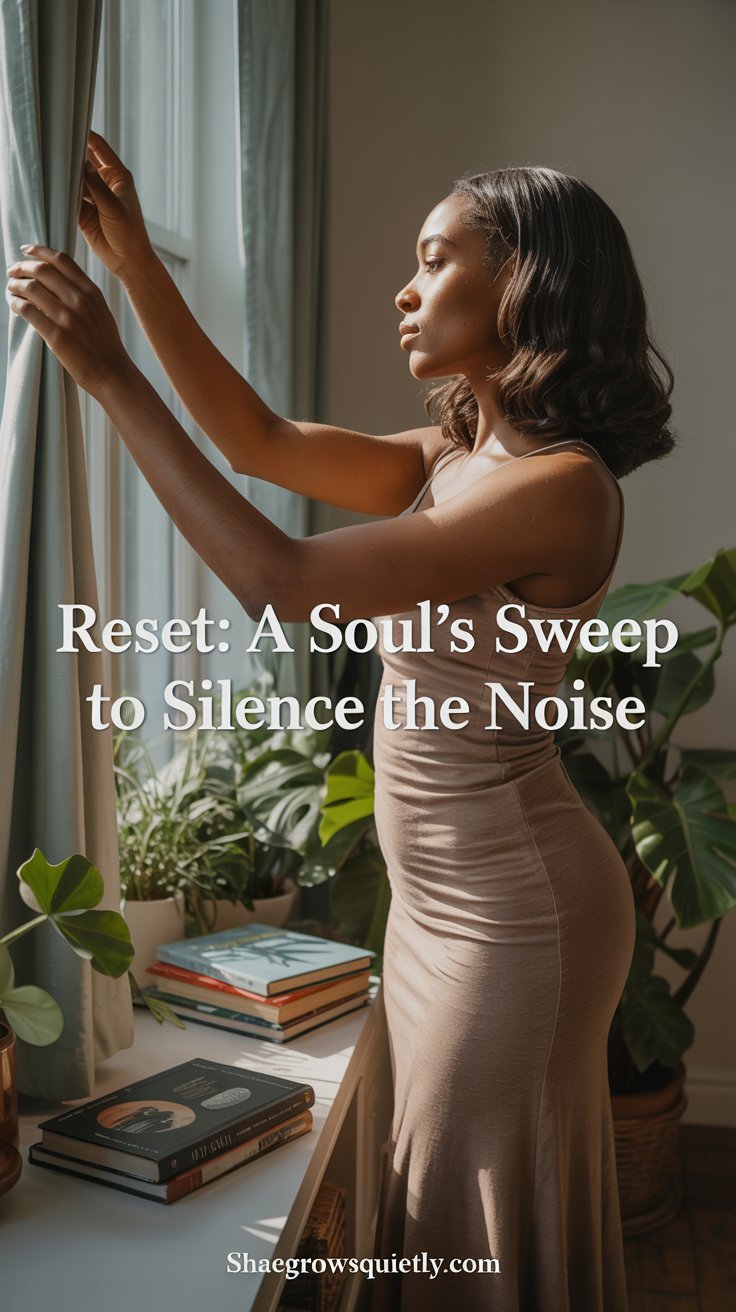
I start by opening a window. Not just to let fresh air in — but to let whatever’s been sitting stale in my spirit out.
Then I sweep. Not just the crumbs and the dust, but the thoughts I’ve been tripping over.
The “what ifs,” the “I should’ve saids,” the heaviness I picked up and forgot to put down.
I water my plants and talk to them soft.
Like I’m checking in on sisters.
You good, baby? You need more sun? Me too.
I wipe the mirrors — not to check for beauty, but to remind myself I’m still here.
Still showing up.
Still worthy of a space that feels like safety, not survival.
I reset my altar — even if it’s just a corner of my dresser.
Lay out a few affirmations, maybe a photo of my grandma.
Speak my intentions aloud, or sometimes just breathe them out and let the smoke carry it.
And you know what?
It don’t have to be deep every time.
Some days, the most sacred thing I do is wipe down the counters, light a candle, and sit in that soft hum of nothingness.
That’s still a reset.
That’s still worship.
That’s still enough.
Picture This: You sway barefoot in your kitchen, warm light spilling through sheer curtains. A soft soul record plays low as incense winds upward. You pause between motions — broom in one hand, memory in the other — and exhale. This isn’t just cleaning. It’s conjuring. It’s reclaiming space as sanctuary.
9. Rest That Doesn’t Have to Be Earned
Because she didn’t get to — and now, I must.
My grandmother didn’t rest.
Not by choice. Not ever.
She was born in a time that asked everything of Black women and gave them nothing back but survival.
She scrubbed white folks’ floors by day, raised their children with grace they didn’t deserve, and came home to raise her own with whatever was left.
She stretched a dollar, cooked from scraps, stood in lines, walked to jobs that broke her body — and still showed up in pressed skirts and pressed hair because dignity wasn’t optional.
She was tired before the sun came up, and still didn’t stop moving until the moon was hanging low.
There were no spa days, no journals, no naps on soft couches in the middle of the day.
Rest wasn’t something she could even imagine.
She didn’t ask for softness because she knew the world wasn’t built to offer her any.
But me?
I live in a world she didn’t get to dream.
And if I don’t stop — if I don’t claim the rest she never could — then what did she labor for?
So I lay down.
Not because the work is done, but because I’m done for now.
I turn off the phone.
Let the dishes wait.
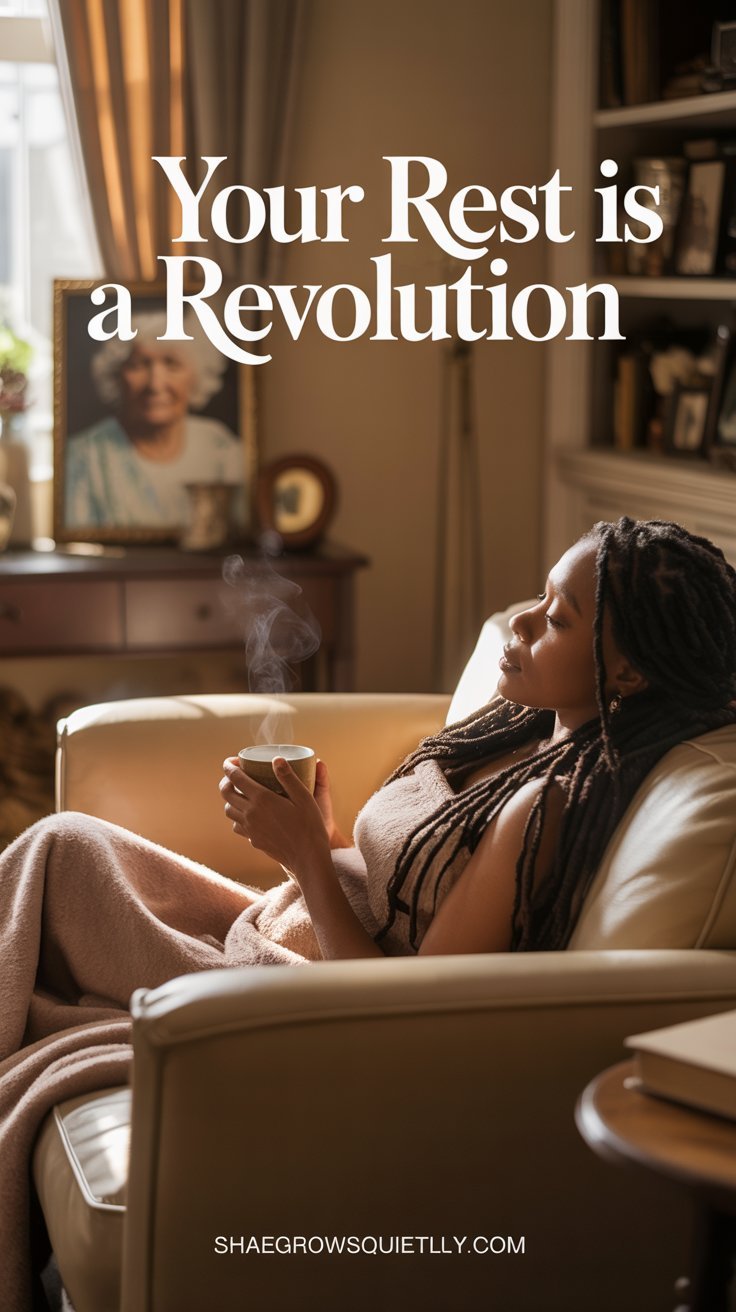
Let my body sink into the couch without apology.
And I say thank you — out loud.
Not just to God, but to her.
To every Black woman who held it all so I could set some of it down.
My rest is not a betrayal.
It is an offering.
It is a small rebellion.
It is how I say:
“I see you. I carry your name. I’m tired too — but I don’t have to die for it.”
And maybe that’s the most radical thing I’ll ever do.
Picture This: The afternoon sun filters through gauzy curtains. You’re curled up on the couch, eyes closed, arms folded across your heart. A photo of your grandmother — young, proud, worn — rests on the shelf nearby. You are resting not as escape, but as reverence. Your stillness says what she never could: “I deserve this. I’m allowed to stop.”
You Don’t Have to Hustle Your Way Back to Wholeness

Listen.
You are not behind.
You are not broken.
You are not lazy just because your body whispers “no more” when the world expects “yes” on command.
Burnout didn’t just drain your energy — it quieted your joy, blurred your reflection, and made you question your own worth.
And when you’ve been stuck in that kind of survival, even healing can feel like pressure.
Even peace can feel unfamiliar.
But baby, healing isn’t another thing to do.
It’s a way to be.
And it starts right here, with you choosing to come back home to yourself.
Not in a rush.
Not in some big dramatic overhaul.
But in quiet, holy ways.
Like resting without guilt.
Like crying without explaining.
Like lighting a candle and reclaiming your time, your breath, your space.
You don’t need permission to begin again.
You don’t need to check off every box before you deserve softness.
You don’t need to prove that you’re worthy of peace.
You are already worthy.
Because you exist.
Because you are.
Because some Black woman before you didn’t make it to this moment — but you did.
So these soft routines?
They aren’t just rituals.
They are resistance.
They are remembering.
They are the quiet revolution of a woman who finally chose herself.
Let the world think you’ve slowed down.
They don’t know you’re coming back to life.
And this time, it’s on your terms —
One prayer-whispered sweep of the floor.
One barefoot breath in the sun.
One long shower after the babies are asleep.
One glass of wine and a Marvin Gaye record.
One boundary.
One moment.
One quiet, defiant yes to yourself at a time.
You don’t have to hustle your way back to wholeness.
You get to grow your way there —
softly, sacredly, and unapologetically.