
You’re still getting things done — but at what cost?
1. You wake up feeling like you haven’t slept at all

You went to bed early. You skipped the extra scroll. You even lit a candle and tried to journal before closing your eyes. You did all the “right” things. But somehow, when morning comes, it feels like the weight of the entire week is already sitting on your chest.
Your limbs are heavy. Your mind is cloudy. And your first thought of the day is already?
This isn’t the kind of tired a nap can fix. It’s the kind that settles deep into your bones — the exhaustion that comes from carrying everything alone, from being strong for too long, from pretending you’re fine when you haven’t felt like yourself in months.
But you get up anyway. Because who else will?
You push through the morning routine on autopilot, muscle memory moving your body while your soul whispers, I need rest. Not just sleep. Real rest. The kind that makes you feel safe, seen, and whole again.
Picture This:
The alarm goes off. You lie still, staring at the ceiling, the room still dark. The thought of another day feels like too much. But you get up. Slowly. Silently. Because that’s what you’ve always done.
This is emotional burnout — the kind that doesn’t care how long you slept or how early you started.
2. You’re irritated by things that never used to bother you

The baby spills her juice. Your partner forgets to take out the trash. Someone at work asks a question you’ve answered ten times already. And suddenly, your chest is tight, your jaw clenched, your voice a little sharper than intended.
You immediately feel bad for snapping. But you’re not mean — you’re maxed out.
You’ve been operating on a stretched wire for weeks, maybe months. Your days are packed, your thoughts are nonstop, and your nervous system is stuck in high-alert mode. There’s no margin left — no room for grace, no softness to land in. Even the smallest inconvenience feels like the final straw.
And the worst part? You can’t tell anyone. You don’t want to be seen as ungrateful. You love your people. You chose this life. But love and overwhelm can coexist — and when your plate is overflowing, even love starts to feel heavy.
Picture This:
You’re standing at the sink, water running, eyes burning as you try to breathe through the frustration. It wasn’t a big deal. But somehow, everything feels like too much.
This is emotional burnout — spilling over in ways you don’t always recognize until after the damage is done.
3. You’re present — but not really there

You show up. You answer the messages, attend the meetings, fold the laundry, hug your babies. But you’re not actually in the moment. Not fully. It’s like watching your life from the outside — doing what needs to be done, but feeling like a ghost inside your own body.
You smile when expected. Say “I’m good” when asked. And sometimes, you even laugh. But joy doesn’t stick the way it used to. It passes through you like light through a window — visible, but not warming anything.
You miss yourself. You miss the version of you that felt alive. The one who danced in the kitchen for no reason. The one who could savor a sunset or get excited about something small. Now everything feels muted — dulled by exhaustion and emotional disconnection.
But you keep going. Because if you stop, you’re not sure what’s waiting in the silence. And that’s the scariest part of all.
Picture This:
You’re sitting on the couch with loved ones, the sound of laughter all around. You smile on cue, but it doesn’t touch your soul. You feel like an observer in your own life — quietly wondering where you went.
This is emotional burnout — the slow fading of joy, hidden beneath performance.
4. The things that used to light you up now feel like labor

There was a time when little things sparked joy.
A cozy trip to the thrift store. A spontaneous journaling session. A long shower with your favorite playlist humming low in the background.
These weren’t just hobbies — they were lifelines. Tiny rituals that reminded you you’re more than what you do.
But now?
Now your journal sits unopened. Your paints are dry. Your candles are burned halfway down, untouched for weeks. You scroll past the things you used to love with a strange ache in your chest — not sadness, exactly. More like absence. Emptiness. Disinterest.
It’s not that you don’t care. You do. Somewhere under the exhaustion, you care deeply. But right now, even joy feels like work.
Even softness feels like one more thing to maintain.
So you shrink. You pull back. You go quiet.
And in that quiet, you wonder if you’ve lost something vital — something that used to make you you.
Picture This:
You finally have a free hour. No one’s calling. The house is still. You sit down with your favorite pen, ready to write… and nothing comes. Just a blank page and a heavier-than-usual sigh.
This is emotional burnout — when even joy feels like another chore you can’t quite complete.
5. Decision-making feels like walking through wet cement

You used to be sharp. Quick. Decisive.
You didn’t second-guess every little thing — what to wear, what to make for dinner, how to reply to a text. But now? Every choice feels weighted, like it requires energy you simply don’t have.
You scroll menus for twenty minutes and still don’t pick a meal. You open your closet and stare blankly. You type out a message, delete it, type it again, delete it again.
You’re not indecisive because you don’t know what you want — you’re indecisive because you’re drained.
Your brain is juggling too many tabs, too many “what ifs,” too many emotional calculations. And underneath it all is a fear of getting it wrong — of making someone upset, or letting something drop, or doing the wrong thing.
So you freeze. Delay. Default.
And beat yourself up for not being able to “just pick something.”
Picture This:
You open the fridge, hungry and tired, but overwhelmed by the number of options. You grab nothing. Close the door. Eat crackers from the cabinet instead.
This is emotional burnout — when the weight of “simple” choices reveals how heavy your mind has become.
6. You overthink everything — and second-guess even more

You’ve always been thoughtful — careful with your words, intentional with your actions. But now, that thoughtfulness has turned on you.
You replay conversations in your head hours after they’ve ended.
You reread messages five times before pressing send.
You wonder if that joke landed wrong. If you sounded too emotional. If you shared too much. If you said too little.
Every word becomes a risk. Every silence feels suspicious.
You doubt your instincts, question your memory, and assume you’re the problem — even when there’s no evidence to support that.
This kind of mental spiraling is exhausting. But you keep doing it because it feels safer than letting something slip.
It’s your brain trying to protect you from rejection, from embarrassment, from vulnerability — but in doing so, it’s eroding your peace.
Picture This:
You lie in bed, eyes wide open, replaying something you said in passing at lunch. You whisper, “Why did I say that?” and feel the guilt wash over you like a wave.
This is emotional burnout — when your mind becomes a maze of self-doubt you can’t find your way out of.
7. You ignore what your body is trying to tell you

Your body has been whispering for a while now.
At first, it was subtle — the occasional headache, the shoulder tension, the heaviness in your chest that lingered longer than usual.
But you brushed it off. Took something for the pain. Kept pushing through.
Then the whispers turned into warnings — jaw clenching, stomach tightness, backaches, shallow breathing — your body begging for pause.
But when you’re used to being in survival mode, slowing down feels like failure.
So you keep going. Keep smiling. Keep checking boxes. All while your body waves red flags like it’s drowning.
Sometimes you don’t even notice you’re tense until someone touches you — a hug, a hand on the back — and you flinch, startled by how rigid you’ve become.
Or maybe you do notice. But rest feels impossible when the world still needs you.
Picture This:
You finally sit down at the end of the day and realize your whole body hurts — not from injury, but from hours of holding everything in. You stretch, but it’s not enough.
This is emotional burnout — when your body keeps the score, and you stopped listening long ago.
8. You isolate — even though you’re craving connection

You used to be the first to reach out. The friend who checked in. The one who never let texts sit too long. But now… even replying feels like work.
It’s not that you don’t care. You care deeply.
But right now, even a simple “how are you?” feels loaded. Feels like pressure. Feels like another emotional tab you don’t have the energy to open.
You scroll in silence. You leave messages unread.
You decline invitations not because you don’t love your people — but because you barely have the energy to be with yourself.
And yet, the silence starts to ache. You miss connection. Miss laughing. Miss feeling seen.
But you don’t want to show up halfway. You don’t want to fake it. You don’t want to answer “how are you?” with another lie.
So you stay quiet. And the quiet gets louder.
Picture This:
You see a missed call from someone you adore. You smile. Your thumb hovers over the screen… then drifts away.
This is emotional burnout — when the need for rest outweighs even the desire for love.
9. Your tears come in secret
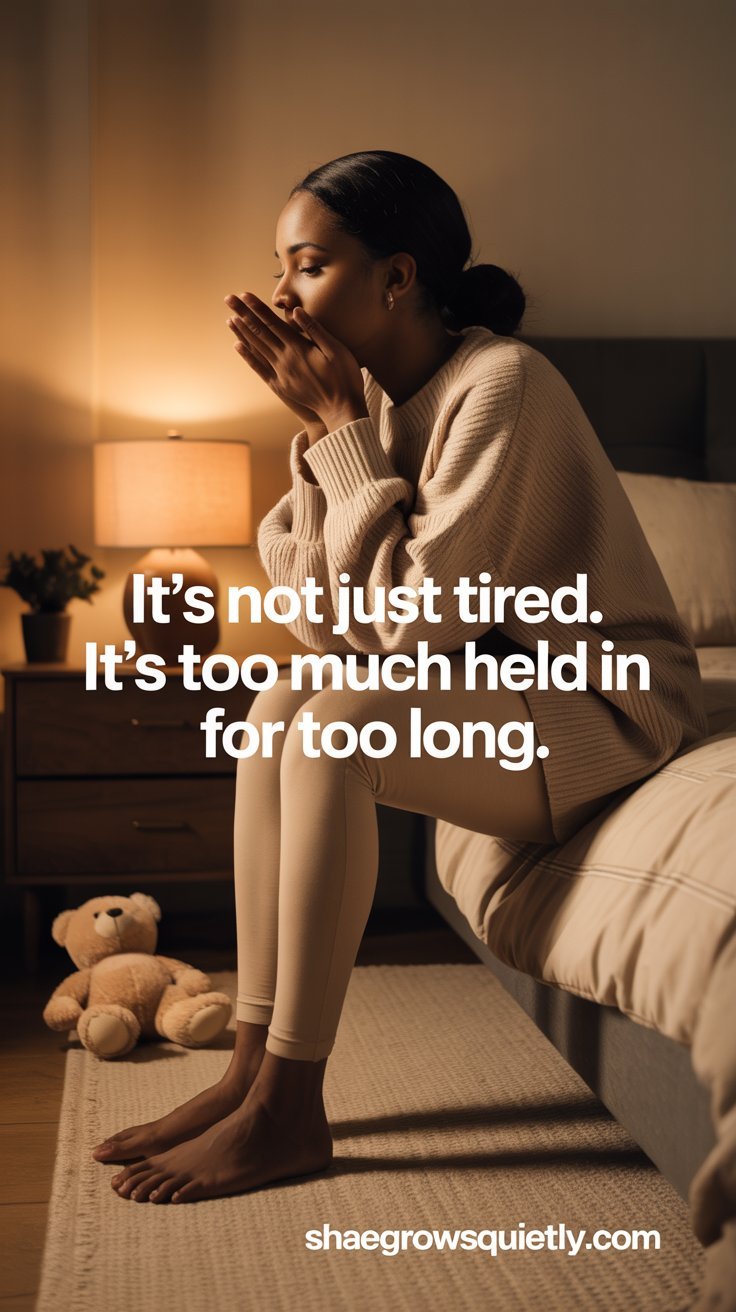
They come in moments no one sees —
in the shower, in your car, behind closed doors.
Quick. Silent. Controlled. You’ve trained yourself to cry without sound.
You don’t want to be a burden.
You don’t want to explain it again.
You don’t want to admit that the strong one is unraveling.
So you hide it.
Tuck the pain behind makeup and productivity. Wipe your eyes before you walk out. Smile at strangers. Say “I’m fine” with a voice that shakes just a little.
These quiet breakdowns have become part of your rhythm — scheduled somewhere between errands and survival.
You tell yourself it’s just hormones. Just stress. Just a rough week.
But deep down, you know it’s more than that.
Picture This:
You’re parked in your driveway, keys still in the ignition. Tears slip down your cheeks as you whisper, I can’t do this today. Then you fix your face, take a breath, and walk in.
This is emotional burnout — the sacred unraveling behind the curtain of strength.
10. You don’t know who you are anymore — only what you do

You’ve spent so long being dependable, capable, strong —
so long being the one others lean on —
that now, when no one needs anything from you… you’re not sure who’s left.
You used to have dreams. Little ones, big ones.
You used to lose track of time doing things that made you feel alive.
Now? You barely remember what you like. You’re not sure what excites you. You feel like a collection of responsibilities wearing a name.
This is more than exhaustion. It’s erosion.
Your identity has been so entangled with what you produce, give, manage, or fix that you forgot you were allowed to just… be.
And you don’t even know where to begin finding her again — the version of you that existed before survival mode became your personality.
Picture This:
You get a rare moment to yourself. No deadlines, no requests. You sit down, and instead of relaxing, you feel hollow. What do you do when no one needs you? Who are you when you’re not useful?
This is emotional burnout — the slow fading of self in the face of constant doing.
Reflection

If you’ve seen yourself in these signs — I want you to breathe.
Right here. Right now.
You don’t have to keep earning your worth through exhaustion.
You don’t have to keep performing wellness while crumbling inside.
You don’t have to wait for a breakdown to finally make rest feel justified.
Emotional burnout doesn’t always come with flashing lights or dramatic collapse.
Sometimes, it shows up in whispers — subtle shifts, gentle disconnections, soft cries behind closed doors.
But just because it’s quiet doesn’t mean it’s not serious.
And just because you’re still functioning doesn’t mean you’re okay.
You’re allowed to choose yourself now.
To say “enough.”
To rest without apology.
To begin again.
Not for the glow-up.
Not to prove anything.
But to come back to the version of you that was never meant to live this tired.
Picture This:
The house is finally still. You light a candle, not for aesthetics, but to remind yourself: I’m still here. I still matter. I still get to heal.
This is emotional healing after burnout — the quiet, sacred return to self.