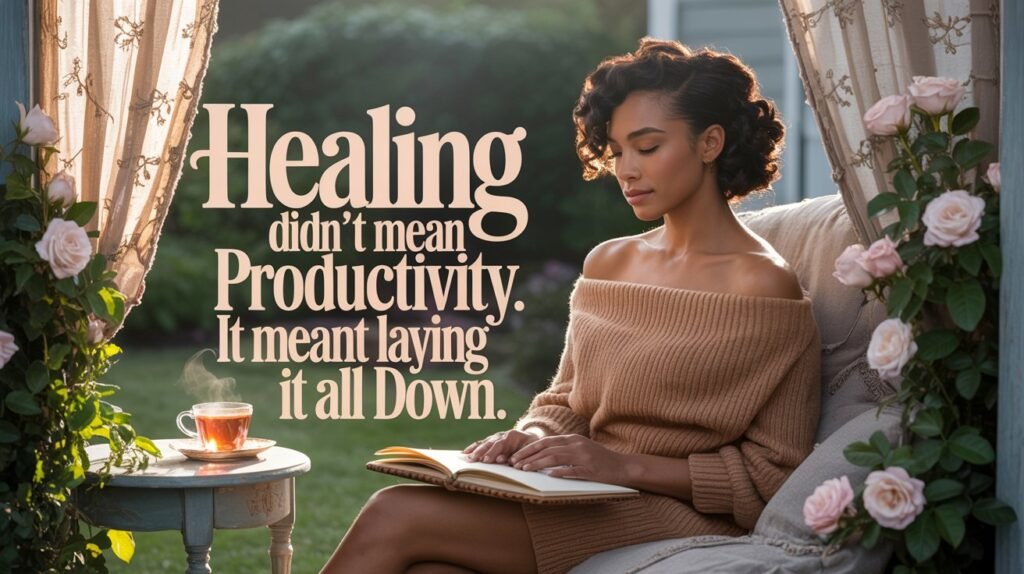
In the hush of healing, I kept asking myself, “When will I feel like myself again?”
But what I didn’t realize was — I wasn’t supposed to go back. I was supposed to lay some things down and never pick them back up.
Not everything I carried was mine to begin with. The expectations. The performance. The strength I wore like armor. Somewhere along the way, I believed healing meant returning to the grind refreshed — like I was supposed to rise from the ashes and get straight to work with a glow and a color-coded planner.
But what if healing was quieter than that?
What if it looked like messy rooms, long naps, undone dishes, and saying “no” with a shaky voice?
What if it meant giving up productivity as proof of worth — and learning how to just be?
This is the story of how I stopped trying to “bounce back” and started gently coming back to myself.
The Lie That Healing Is Just Another Hustle

Somewhere in our culture, healing got hijacked by hustle. We’re told to “do the work,” “glow up,” “boss up,” or come back “stronger than ever” — as if rest itself must be turned into a productivity project.
Even in my burnout, I thought I had to earn my rest.
I made healing a checklist: journaled gratitude, drank my water, deep-breathed through the panic, smiled through the grief. But my body was still screaming. My soul was still sore.
Because real healing?
It doesn’t happen on a schedule. It doesn’t always look like yoga poses and green smoothies. Sometimes it looks like sleeping all day. Crying for no reason. Saying, “I can’t.” Turning your phone off. Questioning everything you once called strength.
And it’s terrifying, especially when you’ve been praised your whole life for pushing through.
But there’s a lie we’ve been told — that we have to prove our progress. That if we’re not being productive, we must be lazy. That if we’re not “better” yet, we must be broken.
Here’s the truth: healing isn’t a comeback — it’s an unlearning.
And unlearning takes time.
Picture This:
You’re wrapped in a soft blanket on the couch, sunlight drifting through the blinds. The dishes are undone, your hair’s a mess, and you haven’t accomplished a thing today. And for the first time in a long while… that feels like enough.
Rest Isn’t a Reward. It’s a Right.
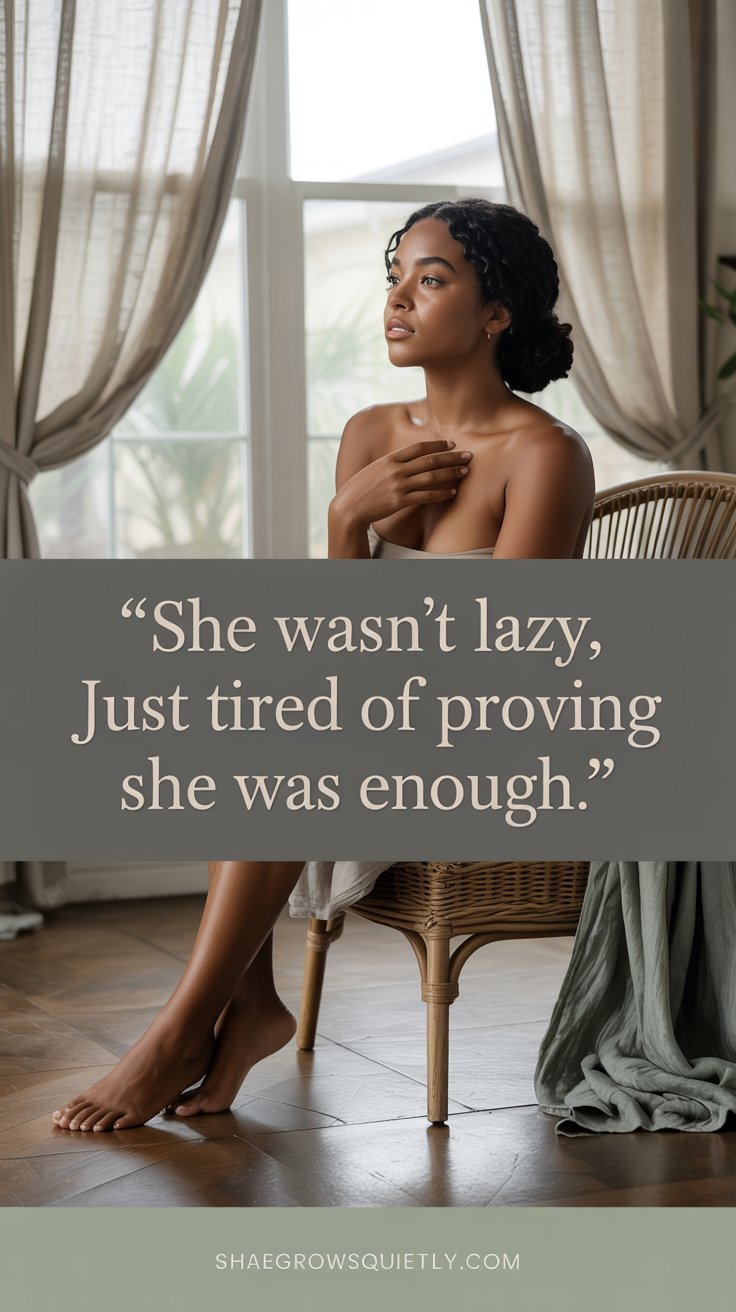
For so long, I believed rest had to be earned. That if I hadn’t worked hard enough, suffered long enough, or produced something useful, I hadn’t deserved it.
It’s wild how deeply that belief can root itself in a woman who’s always been the strong one.
I’d sit down to “rest” but still feel anxious. Like I needed to clean something. Answer someone. Fix something in my life. Be worthy.
But let me tell you what I’ve learned in the quiet:
Rest is not a break between worthy moments. It is a worthy moment all by itself.
You are allowed to pause — not because you’ve checked enough boxes, but because you are human and breathing and healing. You are allowed to do nothing and still be good. Still be enough.
And I don’t mean spa-day rest (unless that’s your thing).
I’m talking about the kind of rest that unnerves you — the kind that says:
“I am letting myself stop… even if the world keeps spinning.”
This kind of rest is spiritual. Revolutionary. Especially for us — the ones who were raised on survival and silence.
It’s not about laziness. It’s about listening. Listening to your nervous system. Listening to your tears. Listening to your breath when it finally slows down.
And in that stillness, you realize: you don’t have to earn being here.
Picture This:
You’re lying on your unmade bed, wrapped in your favorite soft shirt, the one with holes in the sleeves. A journal is open beside you, but you’re not writing — just breathing. The world is loud, but inside this moment, it’s just you… learning to rest without apology.
Productivity Was Never Your Purpose
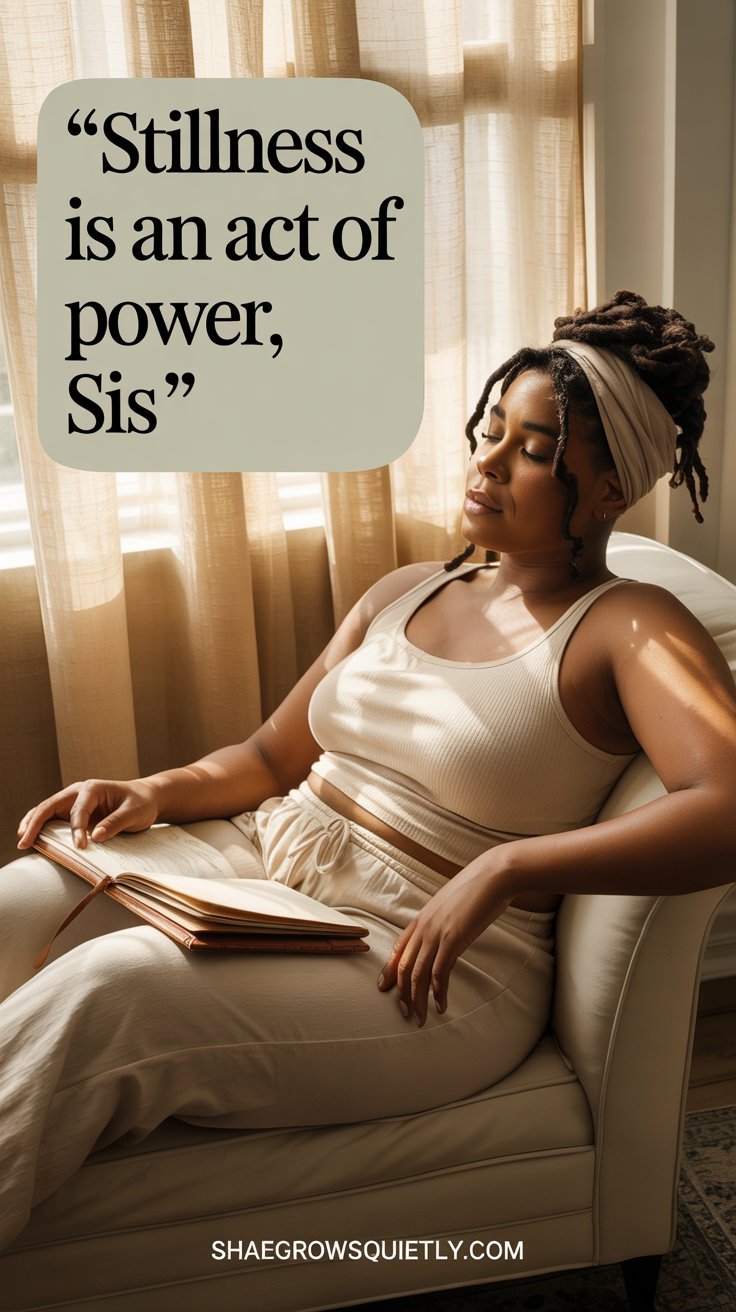
Somewhere along the way, they told us our value was in our output. That if we weren’t grinding, we were wasting time. That if we weren’t useful, we were disposable.
And if you grew up with survival as your baseline — like I did — that lie can feel like gospel.
You start tying your identity to how much you can carry, how much you can get done, how many people you can please. You measure your worth in checklists and chores and how well you keep things from falling apart.
But here’s what I had to unlearn — and maybe you do too:
You are not a machine. You are a miracle.
You were not born to be efficient. You were born to be whole.
And while your productivity might have paid the bills or kept the peace, it was never supposed to cost you yourself.
You don’t have to constantly perform your pain to be seen as worthy.
You don’t have to prove how tired you are to be allowed to rest.
You don’t have to be busy to matter.
Sis, some of the most sacred work you’ll ever do won’t look like work at all.
It’ll look like stillness.
Like boundaries.
Like saying “no” with your chest and “yes” to your own peace.
Like rebuilding a life that honors you — not just what you can do for others.
Picture This:
You’re standing barefoot in the kitchen, staring at the half-finished to-do list on the fridge. Instead of rushing to do more, you whisper to yourself, “That’s enough for today.” You light a candle, sink into the quiet, and finally exhale — not because everything is done, but because you are done trying to prove you’re enough. You already are.
The Rebuild Wasn’t a Hustle — It Was a Homecoming

Healing didn’t arrive with a checklist. It didn’t come dressed in ambition or wrapped in five-year plans. It came like a whisper — one I had to be quiet enough to hear.
At first, I thought I was doing it wrong. The world had trained me to chase milestones, to fix things quickly, to get back to “normal” fast. But healing after burnout doesn’t follow a timeline. It’s not a race — it’s a return.
A return to softness.
A return to truth.
A return to you.
Some days I had energy, and some days I didn’t. And instead of pushing through like I used to, I started asking my body, “What do you need?” That question changed everything.
The rebuild wasn’t loud.
It wasn’t glamorous.
It wasn’t something I could post and get applause for.
It was the quiet miracle of making my bed even when I didn’t feel like it.
Of letting dishes sit in the sink without shame.
Of journaling through grief instead of pretending it didn’t exist.
Of letting the version of me that ran on fumes… finally rest.
What I learned is this: You don’t owe anyone a performance of your healing. You don’t need to explain, justify, or document it. You just need to honor it. Softly. Daily. Truthfully.
And little by little, you’ll find your way back — not to who you were before the burnout, but to someone even more whole.
Picture This:
It’s evening. The sky is lilac and gold. You’re wrapped in a robe, sitting on the porch, journal in your lap. You’re not rushing. Not reaching. Just being. And somehow, in that stillness, you realize… this is the rebuild. Not the doing, but the becoming.
Softness Ain’t Weakness — It’s Resistance Wrapped in Grace
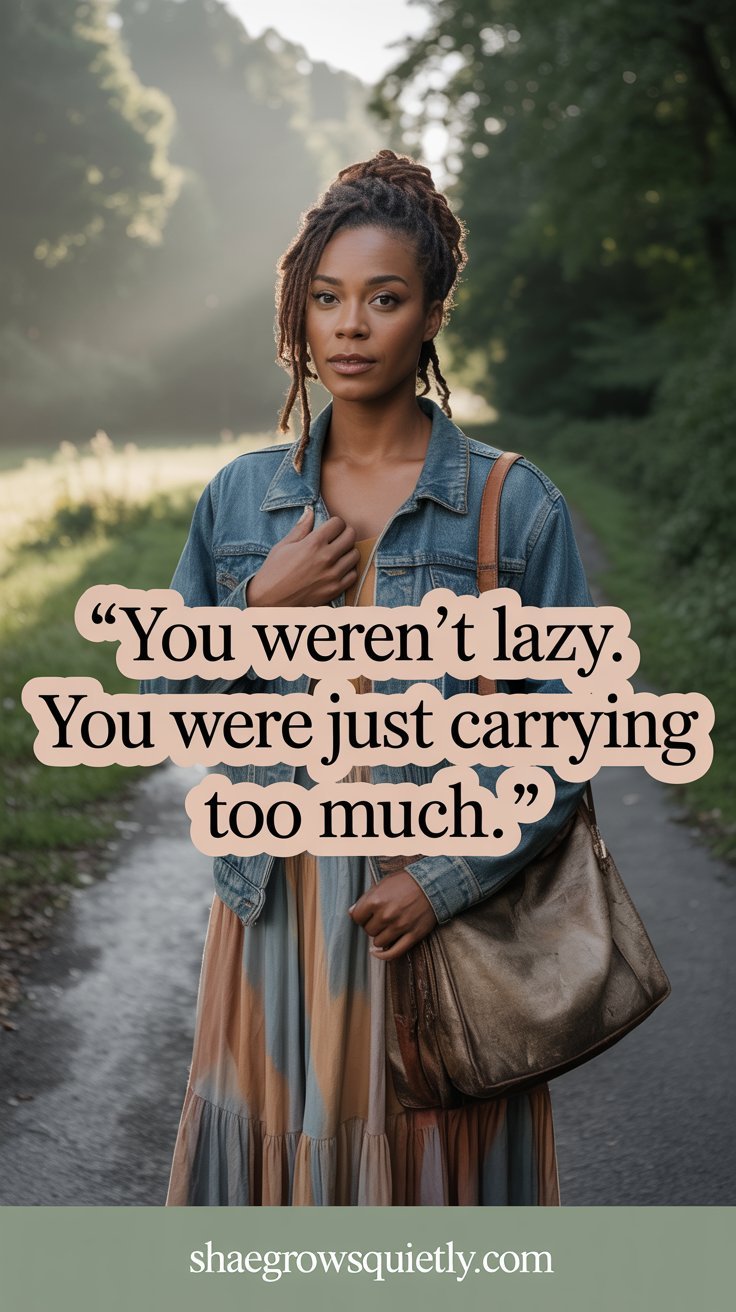
For so long, I wore hardness like armor.
Kept my voice sharp, my shoulders tight, my softness tucked deep under years of survival.
Because somewhere along the way, I learned that gentleness gets overlooked. That if I wasn’t loud or useful or grinding, I’d disappear.
But here’s what nobody tells you:
Softness can be sacred. Softness can be strategy.
And in a world that glorifies the grind, choosing tenderness — for yourself, for your healing — is a radical act of rebellion.
I didn’t unlearn hustle overnight.
It took quiet mornings where I let the sun hit my face before my phone.
It took me learning to cry without apologizing for the mess.
It took naps in the middle of the day, not as a reward, but as a right.
The woman I am now?
She doesn’t flinch when rest calls her name.
She doesn’t confuse stillness with shame.
She knows that her softness is not something to get over —
It’s something to return to.
Picture This:
You’re lying on the couch midafternoon, wrapped in your favorite blanket — the one that smells like lavender and laundry day. The window’s cracked, letting in that golden light, and for once, you’re not multitasking. Just breathing. Just being. Because emotional healing after burnout taught you that softness is not the opposite of strength — it’s the doorway to it.
The Shame of Slowing Down — And Learning to Let That Go

Whew. Now this part right here? It took me a while.
Because nobody tells high-functioning women how to slow down without guilt.
We’re trained to feel bad when we’re not doing, fixing, tending, achieving. Rest feels like rebellion. Pausing feels like punishment. And if you’re anything like I was — slowing down came with shame heavy enough to drown in.
I used to clean the house before I let myself sit down.
Answer emails before I ate.
Return every call, check every box, play every role — before I let myself just be.
Even my rest had rules.
But healing?
Healing said: Baby girl, you don’t have to earn the right to breathe.
So I started noticing the noise in my own head — the one that said I was lazy, weak, falling behind.
And I began responding with softness instead of shame.
I replaced “I should be doing more” with “I’m allowed to rest.”
I started honoring my body’s cues instead of overriding them.
And when that guilt crept in (because it still does), I remind myself:
Slowing down doesn’t mean you’ve stopped.
It means you’ve decided to stop burning out for a life that barely feeds you.
Picture This:
It’s quiet in the kitchen, the kind of quiet that hums peace into your bones. You’re barefoot, robe-tied, holding a warm mug with chipped paint and memories. Outside, nothing’s demanding your time. Inside, you’re learning to sip slowly, listen closely, and leave the shame right there on the counter — next to yesterday’s to-do list. Because emotional healing after burnout taught you: your pace is still sacred, even when it’s slow.
Softness Was the Strength I’d Been Starving For

They told us strength looked like stoicism. Like pushing through the pain and showing up anyway. Like smiling while suffering, enduring while exhausted, performing like our worth depended on it — because it did.
But when burnout took me down to the studs, I found a different kind of strength.
It wasn’t loud.
It didn’t hustle.
It didn’t wear a cape or need applause.
It was soft — and Lord, it was sacred.
The strength I needed looked like saying no with a calm voice and a steady spine.
It sounded like boundaries that didn’t come with explanations.
It felt like grace in the middle of the mess — the kind that doesn’t wait for the house to be clean or the healing to be complete.
Softness taught me to stop performing for peace and start cultivating it.
And it’s still teaching me.
That I’m allowed to take my time.
That peace is not a luxury — it’s a birthright.
That I don’t have to sacrifice myself to prove I’m strong.
Because softness isn’t weakness.
Softness is what held me when everything else fell apart.
Picture This:
The sun’s barely up, golden light pouring over the porch like honey. You’re sitting there in silence — hair wrapped, journal open, soul raw but real. And for the first time in a long time, you feel it: a strength that doesn’t ache. A peace that doesn’t perform. A softness so sacred, it holds space for the woman you’re becoming. That’s emotional healing after burnout — and it’s yours now.
A Quiet Becoming
If you’ve made it this far, you know this wasn’t just about burnout.
This was about the lies we swallowed — that our worth was tied to our work, that rest had to be earned, that softness meant weakness, and that exhaustion was normal if you wanted to “make it.”
But the truth is…
Healing didn’t mean productivity. It meant laying down what was never yours to carry.
All that over-functioning.
All that self-sacrifice.
All that striving to be seen, valued, and safe.
You can put it down now.
You don’t have to keep proving your worth by how much you endure.
You don’t have to keep showing up half-empty just to be enough.
You are enough because you are.
You’re already whole — even if you’re healing.
Already strong — even if you’re soft.
So maybe today, you breathe a little deeper.
Say no without guilt.
Rest without shame.
And trust that the woman you’re becoming doesn’t need to be built in a day. She’s blooming slowly, quietly, and right on time.
Welcome home, sis.