
A slow return to self, one shaky breath at a time.
Shug, Burnout Ain’t Just Tired. It’s Tired-Tired.
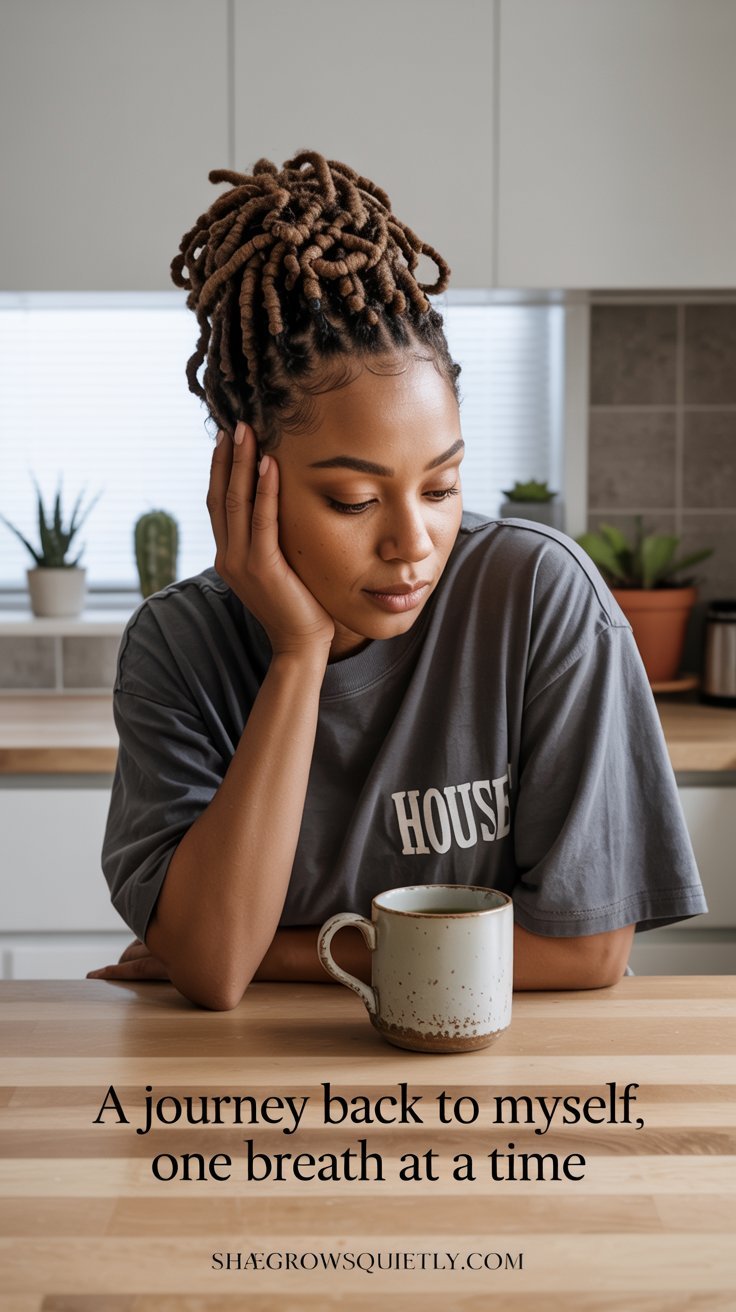
Let’s go ahead and tell the truth — burnout don’t just show up with a sad playlist and a tired sigh. No ma’am. It pulls up with bags under your eyes, an attitude you can’t explain, and a deep ache in your spirit you been trying to ignore for months.
It’s not “Oh, I just need to rest.”
It’s “I’m one group chat away from disappearing on everybody.”
And still… life don’t stop. The bills don’t pause. And if you’re anything like me? You still out here trying to hold it all together with peppermint oil and prayer.
Now listen — I am one of the wellness girlies. I love a good herbal tea and a journaling session with 90’s R&B music in the background. But let’s not pretend recovery is always soft and aesthetic. Sometimes it’s a full-blown spiritual mugshot.
Burnout recovery don’t come wrapped in lavender and eucalyptus.
Sometimes it shows up in pajamas you been wearing for three days and a to-do list you just whispered “God help” over.
But here’s the grace in it:
Healing doesn’t have to be tidy.
It doesn’t have to be fast.
And it sure don’t have to look like anybody else’s.
You’re not failing because you’re still tired. You’re not weak because you need help.
You’re not behind because you had to stop.
You’re just human. And sis — that’s more than enough.
So let’s talk about what burnout recovery really feels like. Not the polished version folks pretend about. But the real, sacred, sloppy, soul-saving truth of it — told by a woman still rebuilding herself, one unglamorous breath at a time.
Picture This: You’re in the kitchen wearing that oversized house T-shirt that seen better days, bonnet halfway off, holding a chipped mug filled with yesterday’s tea. No lashes. No filters. Just peace trying to find its way back home to you.
You Don’t Wake Up Healed — You Wake Up Tired, Again
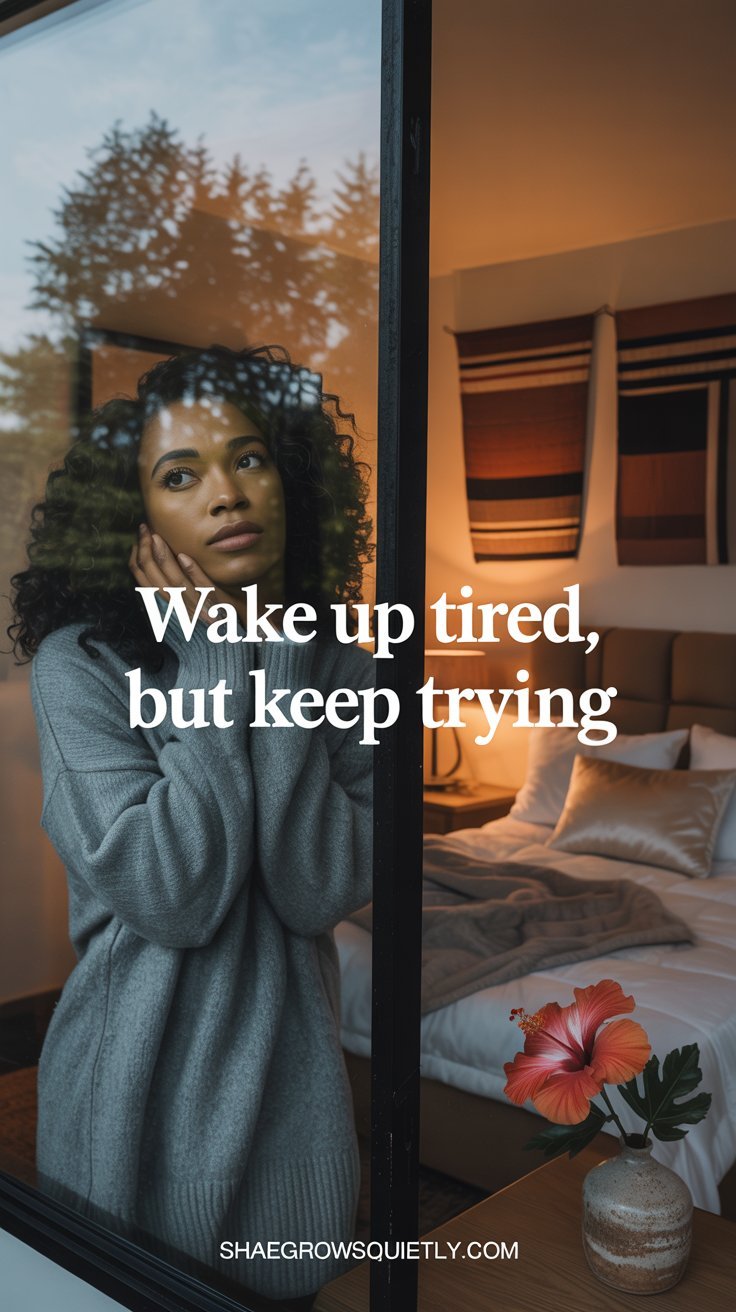
Everybody talks about healing like it’s some kind of mountaintop moment — like you gon’ suddenly wake up one morning, do a gratitude stretch, and feel brand new. But let’s be real: that’s not how this goes.
You don’t wake up floating. You wake up tired.
Not “I stayed up too late” tired.
I mean bone-deep, soul-heavy, I can’t do this no more the way I’ve been doing it kind of tired.
It’s the kind of tired that sleep don’t fix. You can nap, cancel plans, mute your phone — and still feel like you’re dragging yourself through the day with bricks tied to your spirit.
That’s where the healing actually begins.
Not in the face masks or the motivational quotes — but in the quiet moment when you finally admit, “I’m not okay. And I haven’t been for a while.”
Most of us didn’t even realize we were burned out until our bodies gave out or our tears started falling for no reason. Until we found ourselves snapping at folks for asking simple questions or sitting in the car for 45 minutes after pulling in the driveway, just trying to breathe.
That kind of tired will check you. It’ll sit you down, slow you up, and make you confront all the times you kept going when your spirit was begging you to rest.
So no — you don’t wake up healed. You wake up with a lump in your throat, circles under your eyes, and a small, stubborn whisper saying, “Try again. But gentler this time.”
And that’s enough. That’s grace in motion. That’s what real recovery looks like when you’re finally done performing strength for folks who never noticed how much it was costing you.
Picture This:
You sit on the edge of the bed, legs dangling, bonnet sliding back, staring out the window like the breeze might carry a message just for you. The light creeps in slow. The house is still. You’re not rushing anywhere. You let your hands rest in your lap. You breathe deep. And for the first time in weeks, you don’t apologize for needing a moment.
Grief Comes Before Gratitude

Everybody wants you to be thankful.
“Be grateful you have a job.”
“Be grateful you woke up this morning.”
“Be grateful it wasn’t worse.”
And you are. You know how to be grateful — you been doing it your whole life, even when there wasn’t much to hold onto. You smiled through struggle. You gave thanks with a cracked voice and a heavy heart. You made do. You kept going.
But what nobody tells you is that grief has to come first.
Before the gratitude. Before the peace.
You have to mourn what burnout took from you.
The version of you who used to light up.
The ease you used to have waking up.
The way you used to care, without exhaustion dragging behind every gesture.
Burnout doesn’t just drain your energy — it steals pieces of your identity. And sometimes the deepest part of recovery is standing in front of the mirror and realizing… you don’t recognize her anymore.
You miss who you used to be before everything started feeling so hard. And that grief? It’s real. It deserves space. It deserves softness.
You don’t rush grief. You honor it. You weep for her. You write to her. You speak her name in prayer. And only then — only then — can you start reaching for gratitude again. Not the forced kind, but the real kind. The kind that says, “I’m glad I survived, even if I’m still healing.”
Picture This:
You’re sitting cross-legged on the floor, journal open, tears quietly sliding down your cheeks. There’s a candle burning low. No music. No distractions. Just you and the ache — finally given room to breathe. You press your palm to your chest like you’re trying to hold your heart in place. And for a moment, you let the sadness stay without trying to fix it.
The Body Speaks Before the Spirit Does

Before you ever call it burnout, your body already knows.
Before your mind admits you’re drowning, your bones are already aching.
It starts small. A heaviness in your chest you brush off as stress. A tightness in your shoulders you say you’ll stretch away. Fatigue that no amount of coffee can touch. And then it lingers. It grows. Until your body becomes louder than your willpower.
Because while your spirit may try to push through, your body will shut down when it’s had enough.
You get sick more often. You forget things. Your back hurts for no reason. You start waking up already exhausted. You cancel plans, not because you want to, but because you can’t fake it anymore.
And at first, you feel ashamed.
You tell yourself, “Other people have it worse.”
You whisper, “I should be able to handle this.”
You try to outrun your body’s message — until you can’t.
But what if your body isn’t betraying you? What if it’s protecting you?
What if that illness was your warning?
That pain, your boundary?
That fatigue, your soul’s SOS?
Burnout doesn’t ask for permission. It takes. And healing starts when you stop seeing your body’s cry for help as weakness — and start honoring it as wisdom.
Picture This:
You cancel plans you would’ve pushed through a year ago. You turn your phone on Do Not Disturb. You lay down — not as an escape, but as a return. The pillow welcomes your weight like it’s been waiting. You hear your body sigh. And for once, you listen without shame.
Softness Feels Foreign at First

The first time you try softness after surviving burnout, it might not feel like freedom — it might feel like failure.
You lie down in the middle of the day and your body rests, but your mind fights.
You say no to something, and instead of peace, you feel guilt crawling up your spine.
You let a dish sit in the sink, and suddenly you’re spiraling into shame like you’ve let the whole house — the whole world — down.
Because softness ain’t what most of us were raised on. Especially not as Black women. We were taught resilience, not rest. Responsibility, not release.
You watched the women before you carry too much and cry too little.
You learned how to press your edges and your emotions down at the same time.
And when you finally try to do less, to breathe more, to lean into a slower rhythm… it feels unfamiliar. Uncomfortable. Like you’re wearing someone else’s robe.
But that’s not softness failing. That’s conditioning speaking. That’s all the years you were rewarded for overextending, trying to convince you that ease equals laziness.
It doesn’t.
Softness is not weakness.
It is not indulgent.
It is not earned through exhaustion.
It is your birthright.
But like anything sacred, it takes time to reclaim. So go slow. Let your softness be awkward. Let your “no” feel shaky. Let your rest feel raw and rebellious. You’re not doing it wrong. You’re just doing it for the first time.
Picture This:
You’re curled up on the couch in your oldest T-shirt, blanket draped around your shoulders like a cape. The room is quiet, except for the low hum of a fan in the corner. A half-drunk cup of tea sits on the table. You’re not being productive. You’re just being. And even though it feels strange, even though the to-do list is whispering from the kitchen — you don’t move.
The Guilt Tries to Follow You

Even when your body finally gives in to rest, the guilt keeps moving.
It creeps in quiet, like something you forgot to do. You sit on the couch, legs tucked underneath you, wrapped in your favorite throw. The house is finally still, but your thoughts are loud — scanning the room for a task, a chore, a reason to deserve the pause.
Because you weren’t raised to rest.
You were raised to endure.
To perform.
To provide.
To press on.
The women who raised you didn’t have the luxury of rest. They were too busy making a way out of no way — nursing wounds in silence, working twice as hard for half as much, and holding whole families together with tired hands and tight budgets. Rest, for them, wasn’t resistance. It was a risk.
And yet, here you are — learning how to lay down without apology.
How to be still without proving your worth.
How to let the world keep spinning without your hands on the wheel.
And it’s not easy. Because the guilt tries to follow you.
It tells you the laundry is calling.
It reminds you of the email you haven’t answered.
It whispers, “What would she think — your grandmother, your mama — seeing you just… laying there?”
But here’s the truth you’re starting to believe:
Rest is not a betrayal.
It’s a reclamation.
You’re not turning your back on where you come from — you’re turning toward what they never had time to reach.
Every time you let the to-do list wait…
Every time you let your body soften without explaining why…
Every time you rest and don’t feel bad about it…
You’re healing something generational.
You are not lazy.
You are not wasting time.
You are choosing a life they deserved, but couldn’t have.
And shug… that matters.
Picture This:
You’re curled on the couch in the soft light of late afternoon, a basket of unfolded laundry sitting in the corner. You glance at it, then back at the quiet. A sigh rises — not from stress, but release. You tuck the blanket tighter around you, whispering a quiet thank you to the women who never had this chance. And then you close your eyes, knowing rest is your birthright too.
Soft Joy Feels Strange at First

Joy came back like a stray cat.
Not loud. Not sudden. Just… there one morning, waiting by the door like it never left.
At first, you don’t trust it.
You side-eye the smile on your face like it don’t belong to you.
You laugh — really laugh — and catch yourself mid-sound, wondering where that came from.
You feel good for a minute… then guilty for feeling good.
Because when you’ve been hurting for so long, healing feels suspicious.
Like you’ve forgotten something. Like you’re doing something wrong.
And maybe that’s what nobody talks about — the discomfort of peace.
How strange it feels to not be drowning.
How unnatural it is to want soft things again…
A slow walk. A second cup of tea. A warm towel fresh from the dryer.
A playlist that don’t make you cry.
A quiet morning that doesn’t feel like failure.
You’re not used to this version of yourself — the one who giggles while repotting her plants or dances while cleaning the kitchen.
She feels like a stranger.
But shug… she’s you. The real you. The you beneath the exhaustion.
And it’s okay if joy feels unfamiliar right now.
It’s okay if softness makes your skin crawl a little before it settles.
You’re unlearning survival.
You’re remembering how to receive.
This joy isn’t loud.
It doesn’t announce itself with fireworks.
It just shows up in the still moments — and stays a little longer each time you let it.
Picture This:
You’re standing at the sink in a sunlit kitchen, music low, hands in warm water. You look up and catch your reflection in the window — smiling. Not for anyone else. Not for a photo. Just… smiling. And for a second, you pause, unfamiliar with your own softness. But you don’t pull back. You stay. You let it bloom.
Boundaries Become a Survival Tool, Not Just Buzzwords

You don’t set boundaries to be cute.
You set them because something in you knows you won’t survive without them.
When you’re rebuilding after burnout, you start seeing the places where you used to bleed for other people.
Where you said yes when you were already bone-tired.
Where you kept showing up out of guilt, not love.
Where your silence was mistaken for consent.
At first, it feels unnatural.
You say no, and your stomach turns.
You cancel plans, and the shame creeps in.
You send the text: “Actually, I won’t be able to make it.” And then you stare at your phone like it’s going to explode.
But nothing explodes.
The world doesn’t fall apart.
And you — for once — don’t either.
Because boundaries aren’t walls.
They’re doors you choose when and how to open.
They’re a way of saying: “I matter, too.”
You stop answering calls after a certain hour — not out of spite, but because your peace has a curfew.
You don’t attend every argument you’re invited to — not because you don’t care, but because you care too much about your healing.
You give up over-explaining. Over-justifying. Over-extending.
You realize the most loving thing you can do — for yourself and for them — is to stay whole.
You’re not being difficult.
You’re being deliberate.
You’re not avoiding connection.
You’re protecting your capacity to show up when it really counts.
This ain’t about buzzwords.
This is about survival.
And soft living doesn’t mean you let people walk all over you in house shoes.
Picture This:
You silence your phone, toss it on the nightstand, and walk barefoot onto the porch. The evening air kisses your skin. No notifications. No apologies. Just you, a deep breath, and the sound of your own boundaries finally holding. You exhale, and for the first time, it doesn’t feel selfish. It feels sacred.
You Learn How to Hold Two Things at Once

Nobody told you healing would feel like whiplash.
One minute you’re grateful for everything you have.
The next, you’re mad as hell that it took so long to get it.
You smile at the sunrise — then cry while brushing your teeth.
You say thank you and I’m tired in the same breath.
At first, it feels like you’re doing something wrong.
Like joy and grief shouldn’t sit at the same table.
Like you’re being ungrateful for not being happy all the time.
But this is what healing actually looks like:
Bittersweet.
Contradictory.
Both/and.
You can love your life and mourn what it cost.
You can celebrate your strength and still wish you never had to be this strong.
You can forgive and feel the sting.
You can rest and still ache.
That doesn’t make you broken.
It makes you honest.
The world may try to rush you into a clean narrative — “You’re better now, right?”
But you’re not a story arc.
You’re a woman learning how to breathe through the in-betweens.
How to let the light in without erasing the shadow.
Healing isn’t a destination.
It’s a reckoning.
It’s knowing how to cradle your grief and your growth in the same arms — tenderly, without judgment.
Picture This:
You sit in your parked car after a long shift. Your body aches, your feet swollen, your spirit stretched thin. But there’s food in the fridge, your kids are safe, and the sky outside is painted in gold. You feel thankful. You feel tired. You let both truths live. You don’t rush to fix it — you just let yourself feel.
You Begin to Build a Life You Don’t Need to Escape From

It doesn’t happen all at once.
There’s no big announcement, no fireworks, no “aha” moment where everything just falls into place.
Instead, it’s the slow unfolding.
The way peace starts to visit more often.
The way your mornings feel less rushed, even if nothing’s changed but you.
The way you catch yourself humming in the kitchen, barefoot, with the windows cracked — and realize…
you’re okay.
You stop trying to “earn” rest.
You stop holding your breath waiting for the weekend.
You stop needing to numb everything just to get through the day.
You start lighting candles just because.
Cooking a real meal, even if it’s just for you.
Tidying your space like it deserves your love — not your resentment.
You start tending to your life like a garden.
Pulling the weeds. Planting soft rituals. Watering your joy.
This life you’re building?
It’s not flashy.
It’s not always Instagrammable.
But it’s yours.
And it doesn’t require an escape plan.
You don’t dream about disappearing anymore.
You dream about staying. About growing. About blooming slowly into someone you recognize.
You used to live in survival.
Now?
Now you live in your choosing.
Picture This:
You wake up before your alarm, not because you have to, but because your body is rested. The light slips through the curtains. Coffee brews. A quiet joy hums beneath the silence. No drama. No dread. Just a Tuesday morning… and peace that doesn’t ask for permission to exist.
This Is What Coming Back to Yourself Looks Like

It don’t feel like a grand return.
No big moment. No finish line. No “she’s finally healed” celebration post.
Coming back to yourself feels more like… remembering.
Like walking through the house you’ve lived in all your life with the lights finally on.
Like hearing your own voice and realizing you missed her.
You don’t arrive all at once. You unfold.
Slowly.
Gently.
Day by aching, ordinary day.
You start noticing how your laughter sits different in your chest now —
not forced, not polite — but real.
You start showing up for yourself like you used to show up for everybody else.
You start loving on your mornings instead of just surviving them.
And the beautiful, breathtaking part?
It don’t need to look like anybody else’s version of “better.”
It just has to feel like yours.
Because coming back to yourself isn’t about who you used to be.
It’s about becoming the woman you were never allowed the space to be.
The soft one.
The strong one.
The whole one.
She’s always been there — underneath the exhaustion, beneath the performance, buried under decades of doing what you had to do.
And now, piece by piece, you’re bringing her home.
So no, it’s not shiny.
It’s not linear.
But baby, it’s sacred.
And it’s yours to keep.
Picture This:
It’s Friday night, and you’re not out chasing peace — you’re in your living room wrapped in it. No makeup. No agenda. Just music floating through the air, your favorite candle burning low, and your body finally belonging to the moment. You dance slow, not to impress, but to feel. The old you would’ve called this boring. The healed you? You call it home.