
For the woman healing in-between clock-ins, while nobody sees her unraveling — but she keeps going anyway.
There’s a version of healing that nobody talks about.
The kind that happens between clock-ins and commutes.
The kind where you’re still smiling at patients while silently unraveling.
Where “self-care” is choosing not to cry until your lunch break.
Where rest isn’t a luxury — it’s a stolen moment behind a locked bathroom door.
I used to think healing would look like bubble baths, therapy, and time off work.
Instead, it looked like keeping my job while feeling like I was falling apart inside.
This blog is for her — the woman who’s healing quietly, without applause.
The one who’s still showing up even though her heart is tender, her back is tired, and quitting simply isn’t an option.
Sis, I see you. And you’re not alone.
In the Middle of It, I Still Had to Show Up

I didn’t wake up one day and decide to “start healing.” I just broke.
And then I still had to get dressed.
There’s a certain kind of ache that shows up when your soul is begging for rest, but your bills won’t let you stop. When your body says “enough,” but your timecard says “not yet.” I was in that space — the in-between — where you’re too tired to keep going but too responsible to sit down.
Nobody talks about what it’s like to heal while your world keeps spinning. While the laundry piles up, the text messages go unanswered, and you’re still expected to “bring your best self to work.” My best self was buried under survival mode. I was showing up because I had to — not because I had anything left to give.
But somehow, even there… healing found me.
Not in a retreat. Not in some perfectly-timed sabbatical. But in the bathroom stall at work where I cried and wiped my face with rough paper towels. In the parking lot where I screamed inside my car and then walked into my shift with swollen eyes and a fake smile. In those quiet, hidden moments, something in me started to shift.
It wasn’t pretty. It wasn’t Instagrammable. It was survival.
But survival started making space for softness.
Picture This:
You sip lukewarm coffee in your car before your shift starts in the emergency room of a level one trauma center. Your eyes are tired. Your chest is heavy. But you whisper, “Just for today… I’ll be gentle with myself.” In that breath, in that whisper, in that stillness — your healing begins.
The Job Was Killing Me, But I Needed the Check
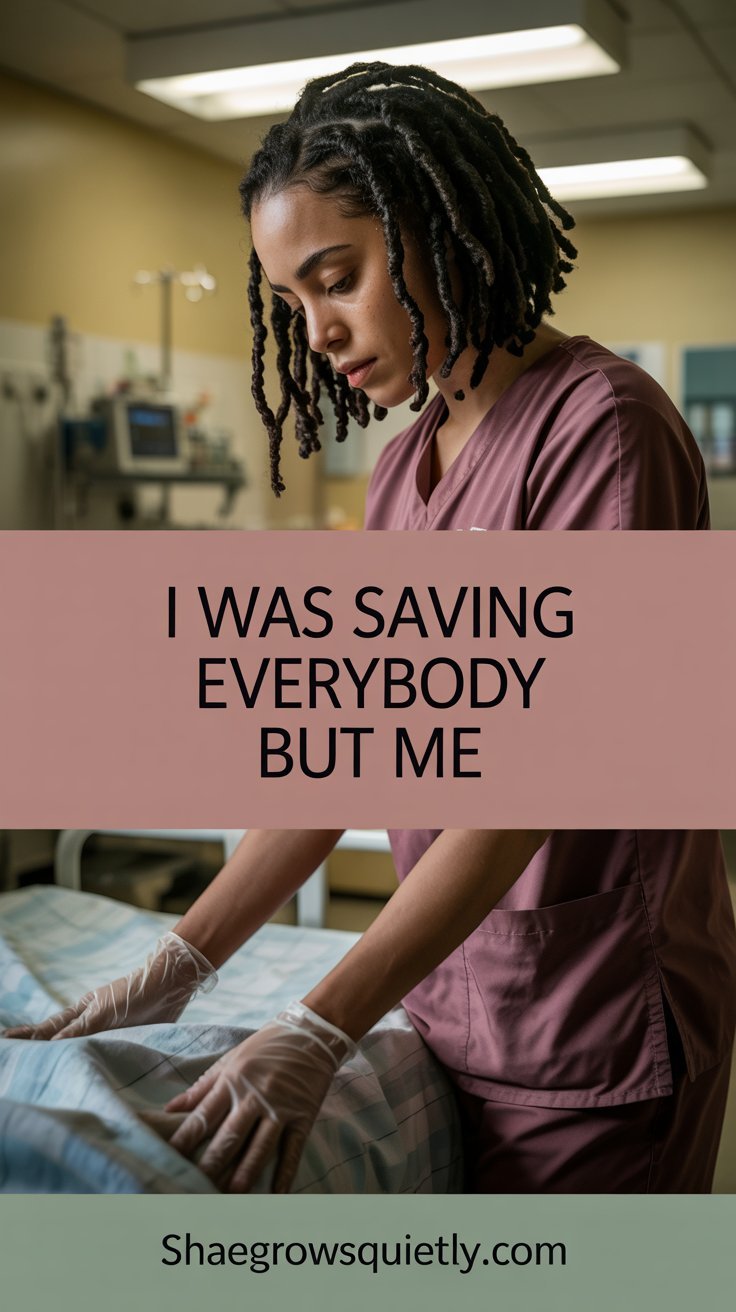
I was a CNA — certified to care for others, but barely keeping myself upright.
Every day felt like a slow bleed. Long shifts. Heavy lifting. The kind of exhaustion that sleep couldn’t fix. I’d clock in with calluses on my feet and a knot in my throat, already counting down the hours ’til I could go home — only to get there and still be needed by everybody else.
They called me dependable. Reliable. A “hard worker.”
But I was dying inside. Quietly. Silently. Softly.
There’s a pain that comes from giving care you don’t even have.
From feeding patients when your own stomach’s empty.
From cleaning rooms while your own life feels like a mess.
From smiling through grief, because nobody wants to hear that the strong one is tired.
And I stayed. Because walking away meant bills unpaid. Kids unfed. A roof not guaranteed.
So I kept showing up — heart heavy, spirit numb, body sore — whispering to God in the supply closet just to get through another shift. That was the reality of healing when I couldn’t afford to stop working: it meant surviving in motion.
I wasn’t lazy. I was depleted.
Picture This:
It’s 4 a.m. The hospital halls are dim and quiet. You’re standing alone in the linen room, head bowed, hands trembling. You close your eyes for 15 seconds — not to pray, not to sleep — just to be. This is emotional healing after burnout: silent, sacred seconds stolen between survival and service.
When Your Body Starts Saying What Your Mouth Can’t

Back then, I wasn’t allowed to fall apart — but my body started doing it for me.
I was always tired. Not just sleepy, but bone-deep weary. Like I had been carrying generations of weight with no rest stop in sight. My back hurt in places I didn’t have names for. My appetite changed. My periods were erratic. I was snapping at my kids for small things and crying in the car with the radio turned all the way up, so no one could hear me breaking.
And the scariest part? I still thought I was being lazy.
Burnout doesn’t always look like quitting. Sometimes, it looks like pushing through the pain until your body forces you to slow down. Mine started whispering first — then yelling.
Headaches. Heart palpitations. Random dizziness. Emotional numbness.
I’d wake up and feel like I hadn’t slept.
Go silent in conversations because I couldn’t fake joy anymore.
Watch myself from outside my own body like a ghost on autopilot.
But no one could see it. To the world, I was “doing fine.”
Inside? I was quietly falling apart.
That’s what emotional healing after burnout really starts with — noticing how burnout talks to your body when your mouth won’t. And choosing not to ignore it anymore.
Picture This:
You’re standing in the mirror, makeup half-done, hands resting on the sink. You look yourself in the eye and whisper, “I can’t keep doing this.” That’s emotional healing after burnout: the moment your reflection tells the truth before your voice can catch up.
Healing Didn’t Look Holy — It Looked Like Survival

When folks talk about healing, they make it sound pretty.
Yoga mats, matcha lattes, a perfect morning routine.
But healing in my world? It looked like doing the bare minimum without guilt.
It looked like giving myself permission to rest without earning it first.
It looked like clocking out, taking off my scrubs, and not answering the phone for nobody but my kids.
There was nothing glamorous about it.
Some days, it was just me eating oatmeal on the floor because I didn’t have the energy to sit at the table.
I didn’t have a therapist yet. I didn’t have a savings account or PTO.
What I had was a body that was tired of being ignored and a spirit quietly asking,
“What would happen if we stopped pretending to be okay?”
So I listened. Slowly.
I didn’t leap into self-care — I crawled into it.
Started lighting candles while I washed dishes.
Started listening to music that made me feel like me.
Started sleeping without shame when the day was done.
Healing didn’t start with a breakthrough.
It started with less — not more.
Less explaining.
Less fixing.
Less pretending.
And in that less… something softer began to grow.
Picture This:
You’re curled up on the couch, dishes still in the sink, hair tied up, body wrapped in a throw blanket that smells like lavender and sleep. It’s not perfect — but for once, it feels enough. That’s emotional healing after burnout: finding peace in the undone.
Boundaries Became My Medicine

At first, I didn’t even know I was allowed to say no.
I was the one who always picked up the extra shift. The one who answered calls on the first ring. The one who people leaned on, because I never said I was tired — even when I was crumbling inside.
But burnout will teach you. It’ll break you down until all you have left is a whisper of yourself.
And that whisper? She finally started speaking up.
The first time I said no — really said it, without guilt, without backpedaling — I felt like I had just dropped a hundred-pound weight I didn’t even know I was carrying.
“No, I can’t come in on my day off.”
“No, I don’t have the energy for company right now.”
“No, I don’t owe anyone an explanation for choosing peace.”
I didn’t set these boundaries because I was healed. I set them because I was hanging on by a thread.
They weren’t pretty or perfectly worded. Sometimes they came out shaky, sometimes sharp. But every boundary was a brick in the foundation of the life I was building — one where I was no longer the afterthought.
Because here’s the truth:
If you don’t protect your peace, the world will pick it apart piece by piece.
Boundaries didn’t make me cold.
They made me clear.
And clarity saved my life.
Picture This:
You’re standing at your front door, hand on the knob, about to answer — but this time, you don’t. You walk away instead, barefoot on the cool floor, heart steady. You light a candle, sink into your favorite chair, and breathe like a woman who just reclaimed a piece of herself. This is emotional healing after burnout — and it starts with saying “no.”
Soft Days, Small Joys, and Not Rushing the Rebuild

There was no grand awakening. No movie-scene moment where I stood up, fully healed, and declared a brand new life.
What came instead were soft days.
Mornings where I let the sun find me before I reached for my phone.
Afternoons where I brewed tea just because.
Evenings where I didn’t force productivity — I just let myself be.
In this chapter, joy looked like small things:
- clean sheets and open windows
- gospel music humming from the kitchen
- a fresh notebook with no expectations
- walks around the block where I actually noticed the flowers
I wasn’t doing much — not by the world’s standards.
But inside?
I was coming back to life.
The pressure to “bounce back” started to fade. I wasn’t interested in returning to who I used to be. That woman was tired, stretched thin, and always performing.
Now, I was asking:
- What feels good to my nervous system?
- What rhythms nourish me, not drain me?
- What parts of my life can be reimagined — softer, slower, sweeter?
Softness, I learned, is not weakness.
It’s the courage to stop before you crash again.
It’s choosing presence over perfection.
It’s rebuilding in whispers, not war cries.
Picture This:
A warm breeze filters through sheer curtains as you stretch across your bed — no alarm, no urgency. The scent of cinnamon tea floats through the room, and sunlight dances across your journal pages. You are safe. You are still. And in this slow, sacred quiet, emotional healing after burnout takes root.
Naming What You Want — Without Guilt

When you’ve been in survival mode long enough, desire starts to feel dangerous.
Wanting more? It felt greedy.
Dreaming big? Felt like betrayal — of my kids, my bills, my responsibilities.
Asking for joy and peace? I thought I needed permission.
But healing cracked something open in me.
Not loud. Not flashy. Just a whisper that said,
“You’ve carried enough. Now you get to choose.”
So I did.
I started naming what I wanted — softly, but clearly:
- A life that didn’t revolve around exhaustion
- Freedom to rest without shame
- Work that felt like purpose, not punishment
- A home that felt like peace, not pressure
- Enough money to breathe without counting every dollar
It wasn’t about luxury. It was about liberation.
Because once you’ve tasted quiet, once you’ve felt your spirit soften —
you don’t want to go back to hard living.
Letting myself want more didn’t mean I was ungrateful.
It meant I was alive.
So, if you’re reading this and still whispering your wants into pillows…
If you feel selfish for wanting softness,
If you’re scared to name the life you crave out loud —
Let me say this:
You don’t have to hustle to deserve peace.
You don’t have to break down to be worthy of breakthrough.
You’re allowed to rebuild slow. To want gentle things.
To want more — and still move with grace.
Picture This:
You light a candle just because. No reason. No occasion. Just you — choosing softness on a Tuesday. Your favorite playlist hums in the background, and as you write down your dreams — not goals, not to-dos, just desires — something stirs in your chest. This is what emotional healing after burnout feels like: safe enough to hope again.
You Didn’t Break. You Were Breaking Free.
If you’ve made it this far, maybe something in your story echoes mine.
Maybe you’re still clocking in with tears behind your eyes.
Maybe you’re still calling rest “lazy” because the world taught you that your worth was tied to your output.
Maybe you’re still healing in silence because slowing down feels too loud.
But sis — you didn’t fail. You paused.
You didn’t give up. You grieved.
And that heaviness you’ve been dragging?
Most of it was never yours to carry in the first place.
Healing after burnout isn’t glamorous.
It’s not always bubble baths and journals and pretty affirmations.
Sometimes it’s ugly crying in the car after your shift.
Sometimes it’s saying no with a shaky voice and a racing heart.
Sometimes it’s leaving dishes in the sink because you chose to rest your body instead.
And that — that quiet rebellion — is sacred.
You deserve a life where your softness isn’t a liability.
You deserve to wake up without dread in your chest.
You deserve to heal out loud, without apology.
So breathe, baby.
You are not behind.
You are not broken.
You are becoming.
One soft choice at a time.